
Description
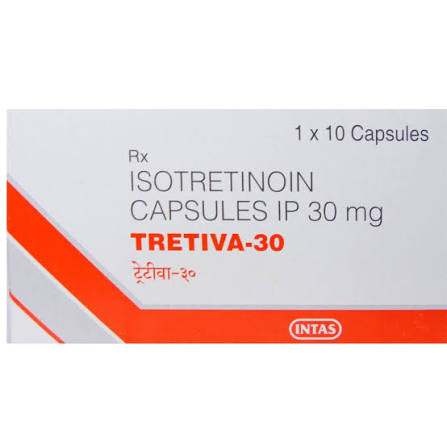
Isotretinoin 30mg is a single capsule strength that sits in the middle of the range dermatologists work with. It is not a “medium” drug or a special formula. It is simply a convenient block of medicine that helps a prescriber build a daily dose that matches your body weight. This page explains the arithmetic behind that choice, so the numbers on your prescription label make sense. It also covers how the capsule is taken, what the label says about side effects and interactions, and how the iPLEDGE system controls every fill. Treat the maths here as a way to understand your plan, not to set it.
Why an isotretinoin 30mg capsule exists at all
Isotretinoin doses are set per kilogram of body weight. That one fact explains why there are so many capsule strengths. US labels for common generic capsules, such as Amnesteem on DailyMed, list 10, 20, 30 and 40 mg capsules. The label also says the daily total is normally split into two doses.
Now picture a prescriber trying to reach a target with only 20 mg and 40 mg capsules. The possible twice-daily totals jump in big steps: 40, 60, 80 mg. A 30 mg capsule fills the gaps. With it in the toolbox, totals such as 30, 50, 60 or 70 mg a day become easy to build from just one or two capsule types. Smaller steps mean the daily dose can track a patient’s weight more closely, and a dose can be nudged up or down without a big jump.
Here is the same idea in a sentence: the 30 mg capsule exists because body weights come in every size, while capsules come in only a few. If you are curious how the lowest steps on the ladder are used, our isotretinoin 10 mg guide for the first month covers the start of a course. At the other end, the isotretinoin 40 mg side-effect manual deals with the highest standard capsule.
Where 30 mg is sold
In the US, 30 mg is a standard strength across several brands and generics. In the UK, the isotretinoin capsule listings we checked on the electronic medicines compendium were 10 mg and 20 mg soft capsules. So a 30 mg capsule is mainly a US strength. A UK patient whose dose works out at 30 mg a day would usually take a mix of smaller capsules instead. Your dermatologist and pharmacist will tell you which products are available where you live.
The two numbers your dermatologist tracks with isotretinoin 30mg
Your prescriber is not only thinking “30 mg” or “60 mg.” Behind the scenes, two calculations drive the whole course. If you learn these two, every dose change will make more sense.
Number one: the daily dose in mg/kg
This is the daily total in milligrams divided by your weight in kilograms. US labels describe a usual range of 0.5 to 1 mg/kg/day, split into two doses. They allow up to 2 mg/kg/day for adults with very severe disease, scarring, or acne mainly on the trunk. The UK summary of product characteristics for isotretinoin 20 mg soft capsules on eMC says treatment should start at 0.5 mg/kg/day, with most patients taking 0.5 to 1.0 mg/kg/day.
Quick worked example: a person weighing 60 kg who takes one 30 mg capsule a day is on 30 ÷ 60 = 0.5 mg/kg/day. The same person taking one 30 mg capsule twice a day is on 60 ÷ 60 = 1.0 mg/kg/day.
Number two: the cumulative dose
The cumulative dose is the total amount of isotretinoin you take over the whole course, again divided by body weight. The UK product information says that going above a total of roughly 120 to 150 mg/kg is not expected to give much more benefit. That range is widely discussed in dermatology literature as a common planning figure.
It is a concept, not a rule you must hit. Guidance is moving. A large US insurance-claims study, reported in 2026 by Dermatology Times, linked higher cumulative doses to fewer relapses, with no extra benefit seen past about 220 mg/kg. Many dermatologists now aim for clear skin plus a sensible total, rather than a fixed number. Your prescriber balances the total against how well your skin responds and how well you tolerate the drug.
Worked examples: three body weights, two daily doses
The table below runs the arithmetic for three example weights. It shows the daily total at 0.5 and 1.0 mg/kg/day, and roughly how many days it would take to reach a 120 to 150 mg/kg total at each level.
Illustration, not a prescription. These figures are arithmetic examples only. Real plans start lower, change with side effects and lab results, and depend on capsule strengths and your prescriber’s judgement. Never change your dose to match a table.
| Body weight | Daily total at 0.5 mg/kg | Daily total at 1.0 mg/kg | Cumulative 120–150 mg/kg (total mg) | Days to reach it at 0.5 mg/kg | Days to reach it at 1.0 mg/kg |
|---|---|---|---|---|---|
| 50 kg | 25 mg | 50 mg | 6,000–7,500 mg | about 240–300 | about 120–150 |
| 65 kg | 32.5 mg | 65 mg | 7,800–9,750 mg | about 240–300 | about 120–150 |
| 80 kg | 40 mg | 80 mg | 9,600–12,000 mg | about 240–300 | about 120–150 |
What the table teaches
Look at the last two columns. The number of days is the same for every weight. That is not a mistake. Because both the daily dose and the target are measured per kilogram, weight cancels out. The time to reach a total depends only on the daily mg/kg level:
- 120 mg/kg ÷ 1.0 mg/kg/day = 120 days, or about 17 weeks.
- 150 mg/kg ÷ 1.0 mg/kg/day = 150 days, or about 21 weeks.
- At 0.5 mg/kg/day, each figure doubles, to roughly 8 to 10 months.
That lines up with the US label, which describes a typical course of 15 to 20 weeks at standard doses. It also shows why lower daily doses usually mean longer courses.
Where the 30 mg capsule fits in the examples
Notice that 32.5 mg and 65 mg are not capsule sizes. Real prescriptions round to what can be dispensed. For the 65 kg example, 30 mg twice a day gives 60 mg, or about 0.92 mg/kg/day. For the 80 kg example, 30 mg twice a day gives 60 mg, or 0.75 mg/kg/day, and the course would take a little longer to reach the same total. These small differences are why prescribers track the running total rather than the capsule count.
People sometimes ask whether isotretinoin 30mg is a “high dose.” The honest answer is that it depends on weight. Thirty milligrams a day is about 0.5 mg/kg for a 60 kg adult, which sits at the lower end of the standard range. For a 30 kg child it would be about 1.0 mg/kg. The capsule strength alone tells you very little.
How an isotretinoin 30mg capsule is usually taken
The exact schedule is written on your prescription label. What the product labels say in general:
- Twice a day. US labels describe splitting the daily total into two doses, and they do not recommend once-daily dosing. Some people are prescribed one 30 mg capsule a day as their whole total; follow the instructions on your own label.
- With food, for most products. The Claravis label on DailyMed says to always take it with food, because absorption falls sharply on an empty stomach. Fat in the meal helps.
- Swallow whole. MedlinePlus advises swallowing each capsule whole with a full glass of liquid, and not chewing, crushing or sucking on it.
- Same times each day. A breakfast-and-dinner routine helps you remember both doses and keeps each one paired with a meal.
If the label language feels dense, our guide to reading a prescription label line by line explains the parts that appear on most pharmacy labels.
The Absorica exception
Not every isotretinoin capsule is the same formulation. The Absorica and Absorica LD label says both can be taken with or without meals. Absorica comes in 10, 20, 25, 30, 35 and 40 mg. Absorica LD uses different strengths (8 to 32 mg) and a lower dose range of 0.4 to 0.8 mg/kg/day, because more of the drug is absorbed. The label states that the two products cannot be swapped milligram for milligram. So “30 mg” of one isotretinoin product does not always equal “30 mg” of another. That is a pharmacist’s question, not a do-it-yourself switch.
When the math changes
The plan your dermatologist writes on day one is a starting point. Several things can change the numbers mid-course, and that is normal.
Side effects
Dry lips, dry skin and nosebleeds are expected. If they become hard to manage, a prescriber may lower the daily mg/kg level. That stretches the course, as the table showed, but it often makes treatment easier to finish. Joint and back aches can also lead to a dose change, especially in people who train hard. If you are active, our piece on exercise and muscle aches while on medication covers sensible pacing. For cramps and spasms in general, see what causes muscle spasms.
Lab results
US labels call for fasting blood fats and liver tests before treatment and at intervals during it. Rises in triglycerides or liver enzymes can lead to a lower dose or a pause. Some people see big jumps in triglycerides. Our overview of managing high cholesterol alongside a prescription explains what lipid numbers mean. The isotretinoin 20 mg monitoring dossier goes deeper into the lab and iPLEDGE monthly cycle.
Weight change
Because the dose is per kilogram, gaining or losing several kilograms shifts your real mg/kg level even when the capsules stay the same. A 10 kg change in a 60 kg person is about a 17% change. Mention it at your monthly visit. For general context, read about how medicines can affect body weight.
Response and relapse
Acne can flare in the first weeks before it improves. Some people clear early. The US label notes a course may stop early if nodule counts drop by more than 70%. Others need longer. If acne returns after a course, the label says a second course should not begin until at least two months off the drug. While waiting, gentle skin care helps; our article on calming pimples quickly lists low-risk options to discuss with your dermatologist. Some people find it helpful to bring notes to each appointment; see these tips for talking to your doctor about a prescription.
US brands of isotretinoin 30mg, and why capsules look different
Several brands and generic makers sell 30 mg isotretinoin in the US. Product listings on DailyMed include Amnesteem, Claravis, Zenatane, Absorica, Accutane and many products sold simply as “isotretinoin capsules.” Not every brand makes every strength, so your pharmacy stocks what is available.
The capsules can look very different from one maker to the next. Two examples from current labels:
| Product | 30 mg capsule appearance (per label) | Taking with food |
|---|---|---|
| Amnesteem (Mylan) | Cream, opaque, imprinted “I30” | Two divided doses with food |
| Claravis (Teva) | Orange, opaque, marked “barr” and “454”, yellow oily fill | Always with food |
| Absorica (Sun) | See your pharmacy leaflet | With or without meals |
Why does this matter? Generic products must show they are bioequivalent to the reference product. That means they deliver the active drug into the bloodstream in a comparable way. Colour, size, imprint and inactive ingredients can still differ. So a change in capsule look between fills is often just a change of supplier. Still, always check. If your capsules look new, ask the pharmacist to confirm the strength and product before you take them. Absorica and Absorica LD are separate cases with their own dosing, as noted above.
Side effects of isotretinoin 30mg, grouped by body system
Isotretinoin side effects tend to rise with the daily mg/kg level, which is one more reason the dose math matters. The table below summarises effects named in US labels and MedlinePlus. It is not a complete list.
| System | Common or expected | Report promptly or get urgent help |
|---|---|---|
| Skin and mucosa | Dry, chapped lips (cheilitis), dry skin, rash, nosebleeds, sun sensitivity, peeling palms | Blistering, peeling rash, mouth sores or fever with rash (rare serious skin reactions) |
| Eyes and ears | Dry eyes, contact lens discomfort | Reduced night vision, blurred vision, hearing changes or ringing |
| Musculoskeletal | Back pain, joint pain, muscle aches | Severe bone or muscle pain, weakness, dark urine |
| Gut and liver | Dry mouth, mild nausea | Severe belly pain, rectal bleeding, ongoing diarrhoea, yellow skin or eyes |
| Brain and mood | Headache, tiredness | Low mood, anxiety, aggression, thoughts of self-harm; severe headache with vision changes or vomiting (raised pressure in the skull) |
| Lab results | Raised creatine kinase after exercise | Large rises in triglycerides, liver enzymes or blood sugar found on testing |
A few practical notes. Night vision can drop suddenly, so take care when driving at night on a new medicine. If you notice blurred vision, ringing in the ears or a persistent headache, contact your prescriber the same day. For mouth dryness, our tips on relieving dry mouth apply here too. MedlinePlus also advises avoiding waxing, laser skin treatments and dermabrasion during treatment and for six months after.
Mood check. US labels warn about depression, psychosis and, rarely, suicidal thoughts. Tell your prescriber and someone close to you about any mood change. Know the warning signs of depression. In the US, call or text 988 for the Suicide & Crisis Lifeline, or 911 in an emergency. In the UK, call NHS 111 or 999.
What not to mix with it
The US labels and MedlinePlus point to a short list of interactions to discuss with your prescriber and pharmacist:
- Vitamin A supplements. Isotretinoin is related to vitamin A, so extra vitamin A can add to its toxic effects. Check multivitamins too. See our guide on checking vitamins and supplements with a prescription.
- Tetracycline antibiotics (such as doxycycline and minocycline). Both drugs are linked to raised pressure in the skull, so labels say to avoid the combination. Our article on antibiotic interactions explains why your pharmacist screens every new prescription.
- Microdosed progestin-only “minipills.” The label says these are not adequate birth control during isotretinoin treatment.
- St John’s wort. This herbal product may make hormonal birth control less effective, which matters a great deal with isotretinoin.
- Systemic corticosteroids. Both can affect bone. Tell your prescriber if you take steroid tablets.
- Alcohol. The NHS suggests it is best to avoid alcohol because of possible liver problems. Read about alcohol and medicine risks, and see our note on liver health and medicines.
Give your pharmacist a full list of everything you take, including over-the-counter products. If you have diabetes, ask about blood sugar monitoring, as labels note glucose changes.
Pregnancy and iPLEDGE: the recap
This is the part that never changes with the dose. Even a single capsule taken during pregnancy can cause severe birth defects or miscarriage.
- Who enrols. All US patients, prescribers and pharmacies must be registered in iPLEDGE. The American Academy of Dermatology notes that prescriptions cover 30 days and that you see your dermatologist every month, in person or by telemedicine.
- Pregnancy tests. Patients who can become pregnant need tests before, during and after treatment. The pre-treatment test is done in a medical setting.
- Two forms of birth control. Labels require two forms of contraception, or a commitment to abstinence, from at least one month before treatment until one month after.
- The 7-day window. The prescription must be picked up within 7 days of the negative pregnancy test. Pharmacies dispense no more than a 30-day supply with no refills.
- Recent changes. The FDA approved iPLEDGE updates in February 2026, including at-home pregnancy tests during and after treatment (if the prescriber allows) and removal of the old 19-day lockout after a missed window. The FDA page says rollout was delayed to 15 November 2026.
In the UK, the NHS isotretinoin page explains the Pregnancy Prevention Programme: contraception from one month before to one month after, and no use during breastfeeding. If you are planning a family later, our general guide on fertility and medicines may help you prepare questions.
Do not donate blood during treatment or for one month after the last dose. Donated blood could reach a pregnant patient. Read more about blood donation rules while on medication. Never share capsules with anyone.
Missed a dose of isotretinoin 30mg?
US labels and MedlinePlus say to skip the missed dose and take the next one at the usual time. Do not take two doses at once to catch up. The NHS gives similar advice: if it is almost time for the next dose, skip the missed one. One missed dose barely moves your cumulative total, so there is no maths reason to double up. For the general concept, see what to do after a missed dose.
If you take too much, call Poison Help at 1-800-222-1222. Call 911 if someone collapses, has a seizure or has trouble breathing.
Storage and disposal
- Store at room temperature, 20–25°C (68–77°F), protected from light, as the US labels state.
- Keep capsules in the original pack, out of reach of children. MedlinePlus advises against the bathroom. Our safe medicine storage checklist has more tips.
- Return unused capsules to your pharmacist, as the UK product information instructs. Do not flush them. In the US, ask about take-back options; see how to dispose of unused medicine safely.
FAQ about isotretinoin 30mg
Is 30 mg of isotretinoin a high dose?
Not by itself. It depends on weight. For a 60 kg adult, 30 mg a day is 0.5 mg/kg, the low end of the usual range. Thirty milligrams twice a day for that same person would be 1.0 mg/kg.
How is an isotretinoin dose calculated?
Your prescriber multiplies your weight in kilograms by a chosen mg/kg/day level, usually 0.5 to 1.0, then rounds to capsule strengths. The total is normally split into two doses.
What is the cumulative dose of isotretinoin?
It is the total amount taken over a course, per kilogram of body weight. UK product information mentions 120–150 mg/kg as a range beyond which little extra benefit is expected. Newer US data suggest some people benefit from more. Your dermatologist decides.
How long does it take to reach 120 mg/kg?
About 120 days at 1.0 mg/kg/day, or about 240 days at 0.5 mg/kg/day. Weight does not change these figures, because both numbers are per kilogram.
Can I take 30 mg of isotretinoin once a day?
US labels do not recommend once-daily dosing and describe two divided doses. Some prescribers still write once-daily plans. Follow your own label and ask your prescriber if unsure.
Why do my capsules look different this month?
Different makers produce 30 mg capsules in different colours and imprints. Generics are bioequivalent, but ask your pharmacist to confirm any change.
Do I need to take it with food?
Most isotretinoin products should be taken with food, as absorption drops without it. Absorica can be taken with or without meals.
Can I drink alcohol while taking it?
The NHS advises it is best to avoid alcohol, because of possible liver effects. Ask your prescriber about your own situation.
Is isotretinoin 30mg available in the UK?
The UK products we checked were 10 mg and 20 mg. A UK dose of 30 mg a day would usually be built from smaller capsules.
Can I get isotretinoin without iPLEDGE in the US?
No. In the US, isotretinoin is only dispensed through iPLEDGE-certified pharmacies to enrolled patients with a valid prescription.
Key takeaways
- Isotretinoin 30mg is a building block for weight-based dosing, filling the gap between 20 and 40 mg.
- Two numbers drive the course: the daily mg/kg level and the cumulative mg/kg total.
- Days to reach a cumulative total depend only on the daily mg/kg level, not on body weight.
- Dose plans change with side effects, lab results, weight change and response. That is expected.
- Most products are taken twice daily with food; Absorica can be taken without food and is not interchangeable with Absorica LD.
- Pregnancy must be prevented. US supply is only through iPLEDGE; UK supply follows the Pregnancy Prevention Programme.
- Skip a missed dose, never double up, and return unused capsules to the pharmacy.
For background on how this drug is used clinically, see the StatPearls isotretinoin chapter.
This description is for information only and does not replace advice from your doctor or pharmacist. Use only as prescribed.
Prescription only. Serious birth-defect risk. Isotretinoin can cause severe, life-threatening birth defects, even after a single dose taken during pregnancy. In the United States it is dispensed only under the FDA’s iPLEDGE REMS programme. You need a prescription from a prescriber registered with iPLEDGE, and US patients can only receive isotretinoin from an iPLEDGE-certified pharmacy after the pharmacy gets an authorisation for that fill. In the UK and EU, it is prescribed under a Pregnancy Prevention Programme, usually by a dermatologist. No order from this page can replace those steps.
Reviews
There are no reviews yet.