
Description
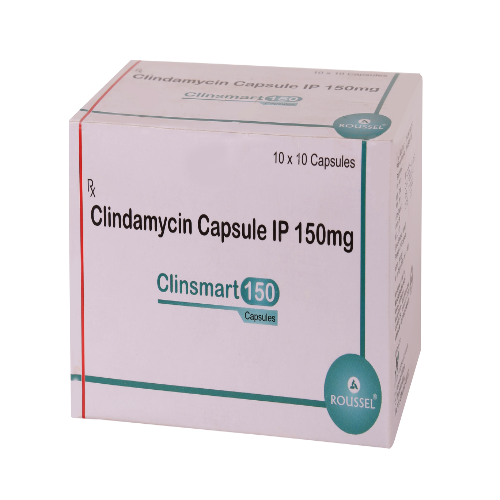
Clindamycin 150mg is the smaller of the two common adult capsule strengths of this antibiotic. Think of it as a building block. Pharmacists and prescribers use it to put together a dose that fits the infection and the patient, one capsule at a time. This page works through the practical side: how 150 mg capsules map onto the doses printed on the label, how to space doses across a real day, what to do when you miss one, what improvement should look like, and the one side effect you must never ignore. It is written for patients and carers who already have a prescription, or who are about to discuss one with a doctor or dentist.
The building-block capsule: why clindamycin 150mg exists
In the US, clindamycin hydrochloride capsules come in three strengths: 75 mg, 150 mg and 300 mg. The brand product (Cleocin HCl) describes the 150 mg capsule as light blue and green. Generic capsules from other makers can look different, so check the imprint against your pharmacy label rather than relying on colour.
Why stock a smaller capsule when a 300 mg one exists? Because the label gives dose ranges, not a single fixed dose. For adults, the current FDA-approved label lists:
- Serious infections: 150 mg to 300 mg every 6 hours.
- More severe infections: 300 mg to 450 mg every 6 hours.
The low end of the first range is exactly one clindamycin 150mg capsule. And 450 mg, the top of the second range, cannot be made from 300 mg capsules alone. So the 150 mg strength lets a prescriber start low, step up in 150 mg increments, or reach 450 mg without splitting anything. Clindamycin capsules should be swallowed whole, not opened, split or chewed, which is another reason a smaller unit is useful.
The capsule is a tool, not a decision. Which rung of the ladder you land on depends on what is being treated, where it is, how severe it is, your weight, your kidney and liver health and what else you take. That decision belongs to your prescriber. If you want to see how the larger capsule fits in, our clindamycin 300 mg product page covers that strength.
One detail specific to the 150 mg capsule
According to the brand label, the 75 mg and 150 mg capsules contain the dye FD&C Yellow No. 5 (tartrazine). The 300 mg capsule does not. Tartrazine can trigger allergic-type reactions, including asthma symptoms, in a small number of people. These reactions are seen more often in people who are sensitive to aspirin. If that applies to you, tell your pharmacist. Generic capsules may use different dyes, so the pharmacist can check the exact product you are given.
The clindamycin 150mg dose ladder
The table below shows how the adult label ranges translate into 150 mg capsules. It is illustrative only. It shows the arithmetic, not a recommendation. Your prescription label is the only dose that applies to you.
| Dose per intake (label range) | Made from 150 mg capsules | Other way to make it | Daily total at every 6 hours |
|---|---|---|---|
| 150 mg (low end, serious infections) | 1 capsule | 2 × 75 mg | 600 mg |
| 300 mg (top of serious / start of more severe) | 2 capsules | 1 × 300 mg | 1,200 mg |
| 450 mg (top of more severe range) | 3 capsules | 1 × 300 mg + 1 × 150 mg | 1,800 mg |
A few practical points sit behind those numbers:
- Two 150s versus one 300. Two clindamycin 150mg capsules contain the same amount of drug as one 300 mg capsule. Even so, never swap strengths on your own. If the pharmacy hands you a different strength from last time, ask them to confirm the number of capsules per dose before you take any.
- Pill burden matters. Three capsules four times a day is twelve capsules daily. Some people find that hard to keep up. If you struggle, tell your prescriber. They may be able to write the same dose using fewer, larger capsules.
- Read the count, not just the strength. Labels say things like “Take 2 capsules by mouth every 6 hours”. The “2” is as important as the “150 mg”. Our guide to reading a prescription label line by line explains each part of a US pharmacy label, and the same layout applies to antibiotics.
The label does not require dose changes for kidney disease, or for older adults with normal liver and age-adjusted kidney function. In severe liver disease, it advises periodic liver tests. Newer label wording also notes that clindamycin can, rarely, harm the kidneys, so your prescriber may check kidney function on longer courses. Background reading on how liver disease affects medicine choices and medicine safety with kidney disease may help you frame questions. Older readers may also find our page on medicine safety in older adults useful.
Children, weight and why capsules often do not fit
Children are dosed by body weight, not by a fixed number of capsules. The label gives a range in milligrams per kilogram per day, split into three or four equal doses, with higher amounts for more severe infections. Weight-based maths rarely lands on a neat multiple of 150 mg.
Here is a simple illustration of the problem. At the bottom of the label’s range, a child weighing 18 kg would need roughly 144 mg in a whole day. Split into three or four doses, that is about 36 mg to 48 mg each time, far less than one clindamycin 150mg capsule. Capsules also have to be swallowed whole, which many young children cannot do.
That is why the label itself says capsules are not suitable for children who cannot swallow them whole, and that they may not allow an exact weight-based dose. In those cases a clindamycin oral solution (clindamycin palmitate) may be prescribed instead. A child’s dose, form and length of treatment are always for the prescriber to set. Keep all antibiotics out of reach of children; our page on keeping medicines safe in a family home has practical storage ideas.
A day on clindamycin: spacing your doses
The adult label wording is “every 6 hours”. MedlinePlus, the US National Library of Medicine’s patient site, describes clindamycin as usually taken three or four times a day at about the same times each day. Your label will say which pattern applies. The point of even spacing is to keep drug levels steady; the label gives an average half-life of about 2.4 hours in adults, so long gaps let levels fall.
| What your label says | Example clock times | Pharmacy-counter tip |
|---|---|---|
| Every 6 hours | 6 am · 12 pm · 6 pm · 12 am | True round-the-clock spacing. Ask your pharmacist whether a night dose is needed or whether waking-hours spacing is acceptable for you. |
| Four times a day | 7 am · 12 pm · 5 pm · 10 pm | Spread across waking hours, roughly 5 hours apart, with a longer gap overnight. |
| Three times a day | 7 am · 3 pm · 11 pm | About 8 hours apart. Anchor the first dose to waking up. |
These times are examples, not instructions. Pick times you can stick to, then set phone alarms. For more on building medicines into your day, see our general guide to timing doses around your daily routine.
The glass of water and the 30-minute rule
This is the advice pharmacists repeat most for clindamycin capsules, and it matters. The label says to take each dose with a full glass of water, about 6 to 8 ounces (200 to 250 mL). It also says not to lie down for at least 30 minutes afterwards. A capsule that sticks in the food pipe can irritate it and, in some cases, cause painful sores.
- Sit or stand to take the capsule. Swallow it whole.
- Drink the whole glass, not a sip.
- Stay upright for 30 minutes. That means planning your last dose of the day at least half an hour before bed.
- If swallowing becomes painful, or you get new or worse heartburn, tell your doctor. Our page on heartburn and acid reflux while on medicines has general background.
Food, alcohol and other medicines
The label says food does not meaningfully change blood levels of clindamycin, so you can take it with or without meals. Taking it with food may help if it upsets your stomach. For general principles, see taking medicines before or after food.
Alcohol is not listed as a direct interaction on the clindamycin label. Still, alcohol can upset the stomach and make it harder to judge whether diarrhoea is a warning sign, so many pharmacists suggest keeping it light or avoiding it while you are unwell.
Clindamycin is broken down mainly by the liver enzyme CYP3A4. Strong blockers of that enzyme can raise its levels, and strong inducers such as rifampin can lower them. It can also boost the effect of neuromuscular blocking drugs used during surgery, so tell the anaesthetist if you need an operation; our page on telling your surgical team about your medicines covers that conversation. If you take pain medicines alongside an antibiotic, our article on combining antibiotics with pain medicines explains the general checks. A full list of your medicines and supplements helps your pharmacist screen for problems; our guide to how drug interactions work explains why.
Missed a clindamycin 150mg dose?
Missed doses happen, especially on a four-times-a-day schedule. MedlinePlus gives the standard approach:
- Take it as soon as you remember.
- If the next dose is nearly due, skip the missed one and carry on with your normal schedule.
- Never double up. Do not take extra capsules to make up for a missed dose.
What counts as “nearly due” is a judgment call. Ask your pharmacist for a rule of thumb that fits your schedule. If you miss several doses, call your prescriber rather than trying to catch up. Our general article on what to do after a missed dose explains why doubling up is risky with many medicines.
If you take too much by mistake, or a child swallows capsules, call Poison Help on 1-800-222-1222 (free, 24/7 in the US) or use the Poison Help service from HRSA. If someone collapses, has a seizure or has trouble breathing, call 911. Our page on what to do right after taking an extra dose walks through the first steps in general terms.
Day 1 to 3 versus day 7: what progress looks like
Antibiotics do not switch symptoms off overnight. Here is what pharmacists typically tell people to watch for. It is general guidance, and your prescriber may give you more specific signs.
| Timepoint | Reasonable to expect | Call your prescriber if… |
|---|---|---|
| Days 1–3 | Fever settling, pain and swelling no worse, then starting to ease. Redness stops spreading. | You feel worse, redness or swelling spreads, fever persists after 2 to 3 days, or you cannot keep doses down. |
| Around day 7 | Clear improvement. Energy returning. Swelling much reduced. | Symptoms have stalled or come back, or you develop new symptoms such as rash or diarrhoea. |
| End of the course | Finish exactly the number of days prescribed, even if you feel well earlier. | Symptoms return after you stop, or diarrhoea starts in the weeks afterwards. |
For strep throat and other beta-haemolytic streptococcal infections, the label says treatment should last at least 10 days. Do not stop early because you feel better unless your prescriber tells you to.
Call 911 or go to an emergency department if you have swelling of the face, lips, tongue or throat, trouble breathing or swallowing, or a spreading dental or facial swelling with fever. Seek urgent care too for a blistering or peeling rash, yellowing skin or eyes, or a big drop in how much you pass urine. The label reports rare severe skin and allergic reactions, including DRESS and Stevens-Johnson syndrome, so any new rash deserves a call.
Pain from a tooth infection can lag behind the infection itself. Our guides to over-the-counter tooth pain relief and Tylenol versus ibuprofen for toothache cover options you can discuss with your pharmacist. For more severe dental pain, see how prescription pain relief is used after dental procedures.
The diarrhoea watch
Do not ignore diarrhoea on or after clindamycin. Contact your prescriber promptly if you get watery or bloody stools, stomach cramps or fever, either during treatment or in the weeks afterwards. The label warns this can start two or more months after the last dose. Do not take anti-diarrhoea medicine unless a clinician has told you to.
Every antibiotic disturbs the normal bacteria in the gut. When that happens, C. diff can take hold and release toxins that inflame the bowel. The CDC’s overview of C. diff notes that the risk is highest during antibiotic treatment and the month after. It also says longer courses raise the risk. That is one reason your prescriber chooses the shortest course that works.
Not every loose stool is C. diff. But you cannot tell the difference at home, so the safe rule is to call. MedlinePlus’s C. diff health topic page explains testing, treatment and hand-washing at home. Mention it to your prescriber if you have had colitis or other bowel problems before.
Dental work and the heart: a guideline that changed
Clindamycin used to be the go-to alternative for people allergic to penicillin who needed antibiotic cover before dental work to protect the heart. That has changed. In 2021, the American Heart Association published an updated scientific statement on preventing viridans group streptococcal endocarditis. It no longer recommends clindamycin for dental antibiotic prophylaxis. As the American Dental Association’s prophylaxis resource summarises, the reason is that clindamycin may cause more frequent and more severe reactions, including C. diff infection, than the other options.
What this means for you:
- If you have a heart condition that needs cover before dental work and you are allergic to penicillin, your dentist or cardiologist will choose a different antibiotic. Do not use leftover clindamycin “just in case”.
- Clindamycin is still prescribed to treat some established infections, including some dental infections, when the prescriber judges it the right choice.
- For many people without a penicillin allergy, an amoxicillin-type antibiotic is the usual dental option. See our amoxicillin 500 mg product page for that drug.
Storage and disposal
The label says to store capsules at controlled room temperature, 20°C to 25°C (68°F to 77°F). MedlinePlus adds the usual practical advice:
- Keep capsules in the original, tightly closed container.
- Store away from heat and moisture. The bathroom cabinet is a poor choice.
- Keep them out of the reach and sight of children and pets.
Our article on storing prescription medicines safely at home has more ideas that apply to any prescription. If you are travelling during a course, keep capsules in your hand luggage with the pharmacy label attached; our tips on travelling with prescription medicines cover the basics.
If you have capsules left over because your prescriber changed your treatment, do not keep them for “next time”. The FDA explains how to find drug take-back locations, including pharmacy drop boxes. If no take-back is available, its guide to disposing of unused medicines describes mixing whole capsules with something unpleasant, such as used coffee grounds, sealing the mix in a bag and binning it. Scratch out your details on the bottle. Our step-by-step medicine disposal guide walks through the same process.
Stewardship: why a clindamycin 150mg prescription is not for every infection
Antibiotics only work on bacteria. According to the CDC’s antibiotic use guidance, colds, flu, most sore throats and most chest colds are caused by viruses, and antibiotics will not help them. Taking an antibiotic when you do not need one still exposes you to side effects, and every use adds to antibiotic resistance.
Clindamycin carries an extra reason for care because of its C. diff warning. The label itself says it should be reserved for serious infections, and for penicillin-allergic patients or others for whom a penicillin is not suitable. Good stewardship from the patient side looks like this:
- Do not ask for an antibiotic for a cold. Our guide to symptom relief for a runny nose covers what helps instead.
- Take every dose as prescribed, for the full length your prescriber set.
- Never share capsules or save them for later.
- Tell your prescriber about any penicillin allergy accurately. Some “allergies” are actually side effects, and testing can open up safer options.
If you are unsure whether you need an antibiotic at all, have that conversation openly. Our tips on preparing questions for your doctor apply to any prescription discussion.
Pregnancy and breastfeeding
The label reports no rise in birth defects with clindamycin used in the second and third trimesters. It advises using it in the first trimester only if clearly needed. Clindamycin passes into breast milk in small amounts. The label says breastfeeding does not have to stop, but the baby should be watched for diarrhoea, thrush or blood in the stool. Discuss your situation with your prescriber. Our pages on questions to ask about medicines in pregnancy and medicines while breastfeeding give general background.
Further reading: the FDA-approved Cleocin HCl capsule label (PDF) and the MedlinePlus clindamycin drug information page.
Questions people ask at the pharmacy counter
How many times a day do you take clindamycin 150mg?
The adult label says every 6 hours. In practice, prescriptions are often written as three or four times a day at evenly spaced times. Follow the exact wording on your pharmacy label, and ask your pharmacist if it is unclear.
Is clindamycin 150mg a strong antibiotic?
Strength is less about the capsule size and more about the drug and the dose. Clindamycin is a potent antibiotic with a boxed warning, which is why the label reserves it for serious infections. The 150 mg capsule is simply the smaller adult building block; your prescriber may give one, two or three per dose.
Can I take two 150 mg capsules instead of one 300 mg?
Two 150 mg capsules contain the same amount of clindamycin as one 300 mg capsule. Only make that switch if your pharmacist or prescriber has confirmed it and your label is updated. Never change the number of capsules on your own.
How long does clindamycin take to work?
Many people notice their fever or pain begin to ease within two or three days. If you feel worse, or not better by then, call your prescriber. Keep taking it for the full course unless told otherwise.
Why do I have to stay upright after taking it?
A capsule that lodges in the food pipe can irritate it. The label advises a full glass of water and staying upright for at least 30 minutes to help the capsule pass into the stomach.
What if I miss a dose?
Take it when you remember, unless the next dose is nearly due. In that case skip the missed dose. Never take a double dose.
Can children take clindamycin 150mg capsules?
Only if the child can swallow capsules whole and the weight-based dose suits the capsule size. The label notes capsules may not give an exact dose for children, so a liquid form may be prescribed instead.
Is clindamycin still given before dental work?
Not for preventing heart infections. The American Heart Association’s 2021 statement no longer recommends clindamycin for that purpose. It is still used to treat some infections, including some dental ones.
Can I drink alcohol while taking clindamycin?
The label does not list a direct alcohol interaction. Alcohol can, however, upset your stomach and mask early warning signs such as diarrhoea. Ask your pharmacist, and keep it light or avoid it while you recover.
How should I store clindamycin capsules?
Keep them at room temperature in the original closed container, away from heat and moisture and out of children’s reach. Take unused capsules to a drug take-back site.
Key takeaways
- Clindamycin 150mg is a prescription-only capsule. Your prescriber chooses the dose and course length for your infection.
- The adult label range runs from 150 mg to 450 mg every 6 hours. The 150 mg capsule lets prescribers build those doses in steps.
- Children are dosed by weight, and a liquid form may fit better than capsules.
- Take each dose with a full glass of water and stay upright for 30 minutes.
- Missed dose: take it when you remember, skip it if the next is close, never double up.
- Call your prescriber about watery or bloody diarrhoea, even weeks after finishing.
- Clindamycin is no longer recommended for heart-protection cover before dental work.
- Antibiotics do not treat colds or flu. Never share or save leftover capsules.
This description is for information only and does not replace advice from your doctor or pharmacist. Use only as prescribed.
Prescription only, and a boxed warning. Clindamycin 150mg capsules need a valid prescription. Your prescriber picks the drug, the dose and the length of treatment based on the infection you have. Do not take leftover capsules or capsules prescribed to someone else.
The US label carries a boxed warning about Clostridioides difficile (C. diff) infection. This gut infection can range from mild diarrhoea to severe, sometimes fatal, colitis. Because of that risk, the label says clindamycin should be kept for serious infections where less risky antibiotics are not suitable. It is not for colds or most other non-bacterial illnesses.
Reviews
There are no reviews yet.