
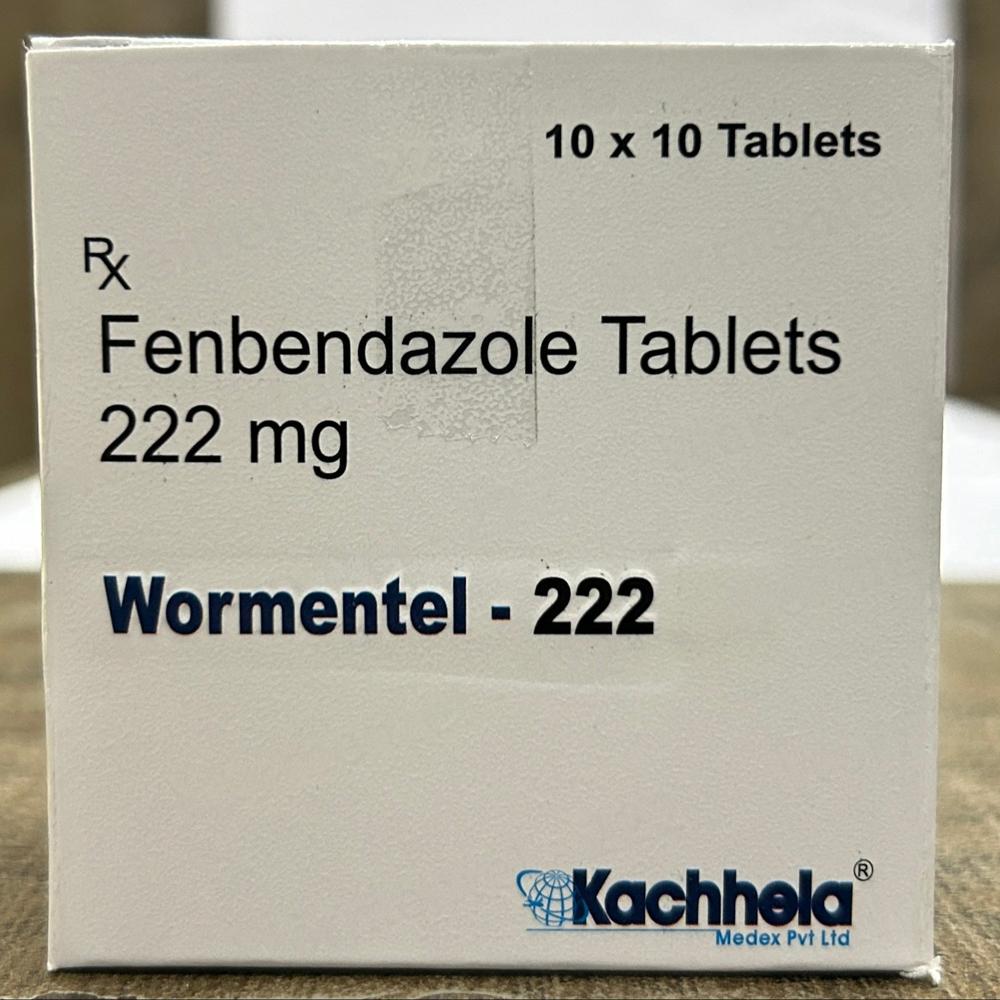
Description
Reading the box: where “fenbendazole 222mg” comes from
The number on the pack is a concentration, not a tablet size. Dog dewormers such as Panacur C and Safe-Guard Canine contain fenbendazole as granules that are 22.2% fenbendazole by weight. Twenty-two point two percent of one gram is 222 milligrams. So when a label or a shop listing says fenbendazole 222mg, it usually means “222 mg of active drug in every gram of granules.”
The US label for Panacur C Canine Dewormer lists the strength as fenbendazole granules 22.2% (222 mg/g). It also explains that the product is sold as 1, 2 and 4 gram packets, and that each packet is meant to be one daily dose for a dog of a certain size. The product is approved by FDA’s Center for Veterinary Medicine for dogs.
Once you know the concentration, the rest of the arithmetic is simple. A bigger packet just holds more granules of the same strength.
| Packet on the dog label | Fenbendazole inside (at 222 mg/g) | Dog weight the label pairs it with |
|---|---|---|
| 1 g packet | About 222 mg | Up to 10 lb |
| 2 g packet | About 444 mg | Up to 20 lb |
| 4 g packet | About 888 mg | Up to 40 lb |
| Packets combined | Adds up | Larger dogs, per the label’s weight chart |
That table explains a lot of confusing search results. “222 mg” is one small dog packet. “444 mg” is a medium packet, or two small ones. Neither figure was chosen with people in mind. They fall out of a dog formula that is measured by weight: the label sets the amount of drug per kilogram of dog, and the packets are sized to cover weight bands.
Why the dose is tied to weight
Most animal dewormers are measured against body weight because a 10 lb terrier and an 80 lb shepherd need very different amounts. Your vet will usually weigh your dog at the clinic. If you weigh at home, the label tells you to round up to the next packet size when your dog falls between two weights. A wrong weight is one of the most common reasons a pet gets too little or too much of any medicine, so it is worth asking the clinic to confirm.
What the rest of the box tells you
Beyond the strength, a veterinary label carries a few more clues worth reading:
- Species line. The canine packets say they are for dogs. That matters, because cat, horse and livestock products differ.
- Approval number. US-approved animal drugs carry a New Animal Drug Application (NADA) number. The Panacur C label lists NADA 121-473.
- Manufacturer and distributor. A traceable company name and US address are a basic sign of a regulated product.
- Warnings. Look for “keep out of reach of children” and any advice about sick or very young animals.
- Storage. The dog granules are labelled for room temperature storage, roughly 68 to 77°F (20 to 25°C).
If you find human prescription labels tricky too, our walk-through on how to read a prescription label uses the same habit of checking strength, directions and warnings before anything else.
The four worms on the canine label
Fenbendazole belongs to a group of dewormers called benzimidazoles. It works against several gut worms that commonly infect dogs. The dog granules list four groups of parasites. Here is a plain-language version of that list.
| Worm group named on label | Species listed | What owners often notice |
|---|---|---|
| Roundworms (ascarids) | Toxocara canis, Toxascaris leonina | Pot belly in puppies, poor growth, sometimes spaghetti-like worms in stool or vomit |
| Hookworms | Ancylostoma caninum, Uncinaria stenocephala | Pale gums, weakness, dark or bloody stool, especially in young puppies |
| Whipworms | Trichuris vulpis | Ongoing diarrhoea, sometimes with mucus; eggs can be hard to find on one test |
| Tapeworms | Taenia pisiformis only | Rice-like segments near the tail or in stool |
Two details on that list trip people up.
First, the tapeworm claim is narrow. The label covers only Taenia tapeworms. The most common tapeworm in pet dogs, the flea tapeworm (Dipylidium caninum), is not on the list. If you see segments, your vet may suggest a different medicine and a flea plan, because dogs catch that tapeworm by swallowing infected fleas.
Second, symptoms overlap. Diarrhoea, weight loss and a dull coat can come from worms, diet, infections or other illness. That is why the label itself says specific diagnoses need lab tests. A quick stool test at the clinic tells your vet which parasite, if any, is there.
Your vet may also talk to you about worms that people can catch from pets. Some dog roundworms and hookworms can infect humans, usually through contaminated soil. The answer to that risk is regular vet care for the dog, picking up stool promptly and good handwashing, not giving people the dog’s medicine. A person with a confirmed worm infection needs a doctor and a human-approved drug, such as the options described on our mebendazole 100mg chewable page for pinworm and other gut worms, or our albendazole 400mg page for certain tapeworm infections.
What the fenbendazole 222mg dog label says about the course
This section reports what the US canine label says. It is not a plan for your pet. Please treat it as background for a conversation with your veterinarian, who may adjust things for your dog’s age, health and parasite.
The label regimen in brief
- Dose basis. The label sets the amount at 50 mg per kg of body weight (about 22.7 mg per lb), given once a day.
- Length. The daily dose is repeated for three days in a row. One deworming “treatment” means all three days.
- How it’s given. The granules are mixed into a small amount of the dog’s usual food. Dry food may need a little water. The label asks you to make sure the dog eats the whole portion.
- Weight bands. The packet sizes cover dogs of roughly 10, 20 and 40 lb, and the label shows packet combinations for bigger dogs. If your dog is between bands, the label points you to the next size up.
Puppies, mums and routine schedules
The Panacur C label describes the product as suitable for puppies aged 6 weeks and older and for adult dogs, including pregnant dogs. For litters, it describes deworming puppies at 6, 8, 10 and 12 weeks, with the mother treated at the same time. For dogs over six months, it suggests deworming at least twice a year. The Merck page for Safe-Guard Canine Dewormer adds that schedules may vary with climate and how active the dog is, which is a polite way of saying: ask your vet what makes sense where you live.
Many vets now tailor deworming to the dog’s lifestyle and test results. A dog that hikes, hunts or lives with young children may need a different plan from a city dog that rarely leaves the pavement. Some monthly heartworm preventives also cover some intestinal worms, though Merck notes they may not cover all four groups on this label. Bring your current parasite products to the appointment so nothing doubles up.
When the label says to wait
The canine label tells owners not to deworm a dog or puppy that is already sick, and to see a vet about the illness first. That is a sensible rule. Vomiting, diarrhoea or lethargy might not be worms at all, and treating the wrong problem can delay the right care.
What side effects the label mentions
In US clinical studies on the dog granules, about 1% of dogs vomited (3 of 240). Pet health references also describe occasional drooling, loose stool and, rarely, allergic reactions. Signs of an allergic reaction in a pet include facial swelling, hives, trouble breathing or collapse. That is an emergency: call your vet or the nearest emergency clinic straight away.
Cats, horses and other animals: different products, different rules
Fenbendazole is used across many species, but each species has its own products and its own label. That is the single most useful thing to remember if you have more than one kind of animal at home.
Cats
In the US, the dog granules are labelled for dogs only. Pet health references note that fenbendazole is not FDA-approved for cats, although vets often prescribe it for cats “extra-label” for certain parasites and it is generally well tolerated in that species. In some other countries, fenbendazole products are licensed for cats. Either way, the choice and the amount for a cat belong to your veterinarian. Please do not split or share a dog packet with a cat on your own.
Horses
Horse dewormers use a different strength. The Panacur Paste 10% for horses comes in a large oral syringe sized for animals weighing hundreds of pounds. Its label carries a blunt warning that it is not for use in humans and must be kept out of reach of children. Horse products are far more concentrated per dose than dog packets. Pet references warn owners never to give a horse product to a dog, because measuring a tiny dog amount from a horse syringe is easy to get wrong.
Cattle, goats, pigs and zoo animals
Fenbendazole products are also approved for several farm species. Products for food animals come with withdrawal times, which set how long to wait before milk or meat from a treated animal can be used. Those rules exist to protect the human food supply, and farmers work them out with their vets.
What “extra-label” means
Extra-label use means giving an approved drug in a way its label does not describe: a different species, a different parasite, a different dose or a different length. Under US law, only a licensed veterinarian can direct this, and only within a real vet-client-patient relationship, where the vet knows the animal and is available for follow-up. FDA’s guide to extra-label drug use in animals sets out those conditions. In short, extra-label is a vet decision, not a pet owner workaround.
The same idea applies to every medicine a pet takes. Our guides on how gabapentin is used for dogs’ pain and anxiety and when vets prescribe alprazolam for dogs show how carefully dose and species are matched, and our article on combining gabapentin and tramadol in dogs explains why vets check every medicine a pet already takes.
Other medicines that end up in the same pet cabinet
A dewormer is rarely the only animal medicine in a household. Older dogs may also be on pain relief, and puppies may be on flea and tick products. Mixing up packets, tablets and syringes between pets, or between pets and people, is a common way accidents happen.
A few points worth keeping in mind:
- Human painkillers are not pet painkillers. Some human medicines are dangerous for dogs and cats, even in small amounts. Our page on why opioid painkillers from your own cabinet are risky for dogs explains why.
- Vets weigh pain options carefully. If your dog has arthritis or post-surgery pain, our comparisons of tramadol and carprofen (Rimadyl) for dogs and Deramaxx versus tramadol for canine pain outline what your vet may consider.
- Tell your vet about every product. That includes dewormers bought at a pet store. The vet can then judge any overlap and check timing.
Keeping fenbendazole 222mg granules safe at home
Granule packets are small, light and often tucked into a kitchen drawer near the dog food. That makes them easy for children and other pets to find. FDA’s advice on storing pet medications safely covers the main points, and we have added a few clinic-style tips.
Where to keep it
- Keep packets in their original box so the strength, species and directions stay with them.
- Store them somewhere locked or high and closed, not just high. Cats climb and dogs jump, and flavoured products attract both.
- Keep pet medicines apart from family medicines, ideally in a separate box or bag labelled with the pet’s name.
- Do not count on child-resistant packaging. Determined dogs chew through vials and blister packs, and young children open more than adults expect.
- Mix the day’s dose right before feeding. Don’t leave a medicated bowl where a toddler or another pet can reach it.
Our general guides to locking away medicines in a family home and protecting children and visitors from household medicines were written for human prescriptions, but nearly every tip carries over to pet products. For day-to-day habits, see also safe medicine routines at home.
If a child swallows dog dewormer
Stay calm and take the packet away. Check how much is missing. Then call a poison centre, even if the child seems fine. Poison centre staff deal with pet medicines swallowed by children often, and most calls are handled without a trip to hospital. Our article on what to do right after an accidental extra dose covers the general first steps for any medicine mix-up.
Poison and emergency numbers
- A person swallowed it (adult or child): phone Poison Help on 1-800-222-1222. It is free, confidential and open 24/7 across the US. If the person is unconscious, has a seizure or has trouble breathing, call 911.
- A pet ate too much or got into the box: call your vet or nearest emergency animal hospital. You can also call the ASPCA Animal Poison Control Center at (888) 426-4435 or the Pet Poison Helpline at (855) 764-7661. Both run 24/7 and charge a consultation fee.
- Have the box or packet in hand when you call, so you can read out the product name and strength.
If your pet gets into the packets
Pet health references describe fenbendazole as having a fairly wide safety margin in dogs and cats, and a single overdose is usually not expected to cause severe poisoning. Still, treat it as a vet call, not a wait-and-see. Your vet will want to know your pet’s weight, how many packets are missing and when it happened. Also check whether anything else was in the drawer, because the bigger danger is often a second product.
When the course is finished
Leftover packets are tempting to keep “for next time.” Talk to your vet first, because the next infection may need a different drug, or your dog’s weight may have changed. If you won’t use them, follow local guidance on medicine disposal. Our guide to getting rid of unwanted medicines safely covers take-back sites and household disposal steps.
Why a dog dewormer shows up in human searches
If you have typed fenbendazole 222mg into a search engine, you have probably seen it mixed with talk about people, often people with cancer. That trend grew from a widely shared personal story and social media posts claiming the dog granules helped. Our main guide, fenbendazole for humans and what the evidence shows, covers that history and the research in full. Here is the short version for pet owners.
Fenbendazole is not approved for use in people for any condition. The American Cancer Society’s 2025 explainer, what to know about fenbendazole, says the drug has not been tested in human studies and that the FDA has never approved it for human use. The same article notes that the few published case studies of people with cancer who took it describe liver inflammation and damage, and that it may interact with cancer treatment.
The 222 mg number on a dog packet was never set for a human body. People differ from dogs in how they absorb and clear drugs, which is one reason species-specific testing matters. If you want to understand that idea, see our explainer on why the same medicine behaves differently in different bodies, and our guide to how the liver breaks down medicines.
Our related posts look at other angles of this topic:
- If someone in your family has already taken a product, our guide to fenbendazole 150mg safety and liver checks explains what to tell a doctor.
- For the capsules and tablets marketed for people online, see how to judge unregulated fenbendazole 444mg products.
- For the cancer research itself, our fenbendazole 500mg research tracker explains how to read the studies.
If you are worried about a relative who is using the dog granules themselves, the kindest step is usually to encourage them to tell their doctor what they are taking, without judgement.
Buying veterinary dewormers from a source you can trust
In the US, the canine fenbendazole packets are widely stocked by vet clinics and pet retailers, and some fenbendazole products need a vet’s prescription. Wherever you buy, the goal is the same: a genuine, correctly stored product with a full label and a company that stands behind it.
FDA’s “A.W.A.R.E.” checklist
FDA’s Center for Veterinary Medicine publishes a short A.W.A.R.E. guide to buying pet medicines online. Its main points, in our own words:
- Ask your vet first. They know your pet’s health, weight and other medicines.
- Watch for red flags. No prescription asked for a prescription-only pet drug, no licensed pharmacist to talk to, no US address or phone number, prices far below other sellers, or payment only by wire transfer or crypto.
- Check the licence. US pharmacies must be licensed by the state board of pharmacy where they operate and where they ship.
- Report problems. Tell your vet first, then the manufacturer or FDA about any suspected side effect or bad product.
- Educate yourself. A few minutes of checking protects you and your pet.
Signs a “fenbendazole 222mg” listing is not what it seems
- It is sold as capsules or tablets “for adults” rather than as dog granules with a species label.
- The page talks about cancer, “detox” or “parasite cleanse” for people.
- There is no manufacturer, no approval number and no expiry date in the photos.
- The listing copies the 222 mg figure but shows a product that looks nothing like the dog packets.
Products like these are not checked by a regulator for what is inside. If you want to know how a properly regulated medicine travels from factory to pharmacy shelf, our guide to how medicine supply chains are regulated explains the checkpoints. You can also see how we describe our own site’s checks on our page about whether NewLifeMedix is legitimate.
The same caution applies to other animal antiparasitics. Ivermectin, for example, comes in very different animal and human products. Our ivermectin 3mg page describes the human prescription tablet and its approved uses.
Fenbendazole 222mg: questions pet owners ask
What does 222 mg of fenbendazole mean?
It means 222 mg of fenbendazole in each gram of granules. The dog products are 22.2% fenbendazole by weight, so 1 g of granules holds 222 mg of the active drug.
How much fenbendazole is in a 1 gram packet?
About 222 mg. A 2 g packet holds about 444 mg, and a 4 g packet about 888 mg. The label pairs each size with a dog weight band.
What worms does fenbendazole treat in dogs?
The US dog label covers roundworms, hookworms, whipworms and Taenia tapeworms. It does not cover the common flea tapeworm, and it is not a heartworm treatment.
How many days do you give fenbendazole to a dog?
The canine label describes a daily dose given for three days in a row, mixed into food. Your vet may recommend a different plan for your dog’s parasite, so check before you start.
Can cats take fenbendazole?
Vets do prescribe it for cats, but in the US that is extra-label use. Only your vet should choose the product and amount for a cat. Don’t share a dog packet with your cat.
Can I use horse fenbendazole paste on my dog?
No, not on your own. Horse paste is made for animals weighing hundreds of pounds, and measuring a small dog’s share is easy to get wrong. Use a dog product, or ask your vet.
Do you need a prescription for fenbendazole for dogs?
Some fenbendazole dog packets are sold without a prescription in US pet stores, while other forms need a vet’s order. Even when you can buy it freely, a stool test and a vet’s advice help you treat the right worm.
What if my child eats dog dewormer?
Take the packet away, note how much is missing and phone the Poison Help line (1-800-222-1222) straight away. If your child is very drowsy, has a seizure or struggles to breathe, call 911.
Is fenbendazole 222mg safe for humans?
It has not been tested or approved for people. The American Cancer Society reports liver damage in published case studies of people who took it. It is a dog medicine, and nobody should take it themselves.
Key takeaways
- Fenbendazole 222mg is a concentration: 222 mg of fenbendazole per gram of 22.2% dog granules.
- Packets of 1 g, 2 g and 4 g contain about 222, 444 and 888 mg and are matched to dog weight bands on the label.
- The US dog label covers roundworms, hookworms, whipworms and Taenia tapeworms, given daily for three days; your vet confirms what your dog needs.
- Cats, horses and farm animals use different products. Using one species’ product in another is a vet decision.
- Store packets in their box, locked away from children and pets. For people call 1-800-222-1222; for pets call your vet or an animal poison line.
- Fenbendazole is not approved for human use. Doctors have published reports of liver injury in people who self-treated with it.
- Buy from your vet or a licensed, transparent retailer, and use FDA’s A.W.A.R.E. checklist online.
This description is for information only and does not replace advice from your doctor or pharmacist. Use only as prescribed.
You have a box of dog dewormer on the counter, the label says fenbendazole 222mg per gram, and you want to know what that number actually tells you. This guide reads the label with you, line by line, the way a vet nurse might at the front desk. We cover what the strength means, which worms the dog product is labelled for, how the packets relate to your dog’s weight, how to store the granules safely at home, and why this pet medicine keeps turning up in searches by people. One thing up front: fenbendazole is a veterinary drug. It is not approved for human use, and nothing here is a dose for a person.
For animals only, and your vet is the right person to ask. Your veterinarian decides whether your pet needs a dewormer, which product fits the parasite found, and how long to give it. Please don’t use leftover packets from another pet, share them with a friend’s animal, or take any of the granules yourself. Different worms, species and health conditions call for different choices, and some pets should not be dewormed until an illness is checked.
Reviews
There are no reviews yet.