
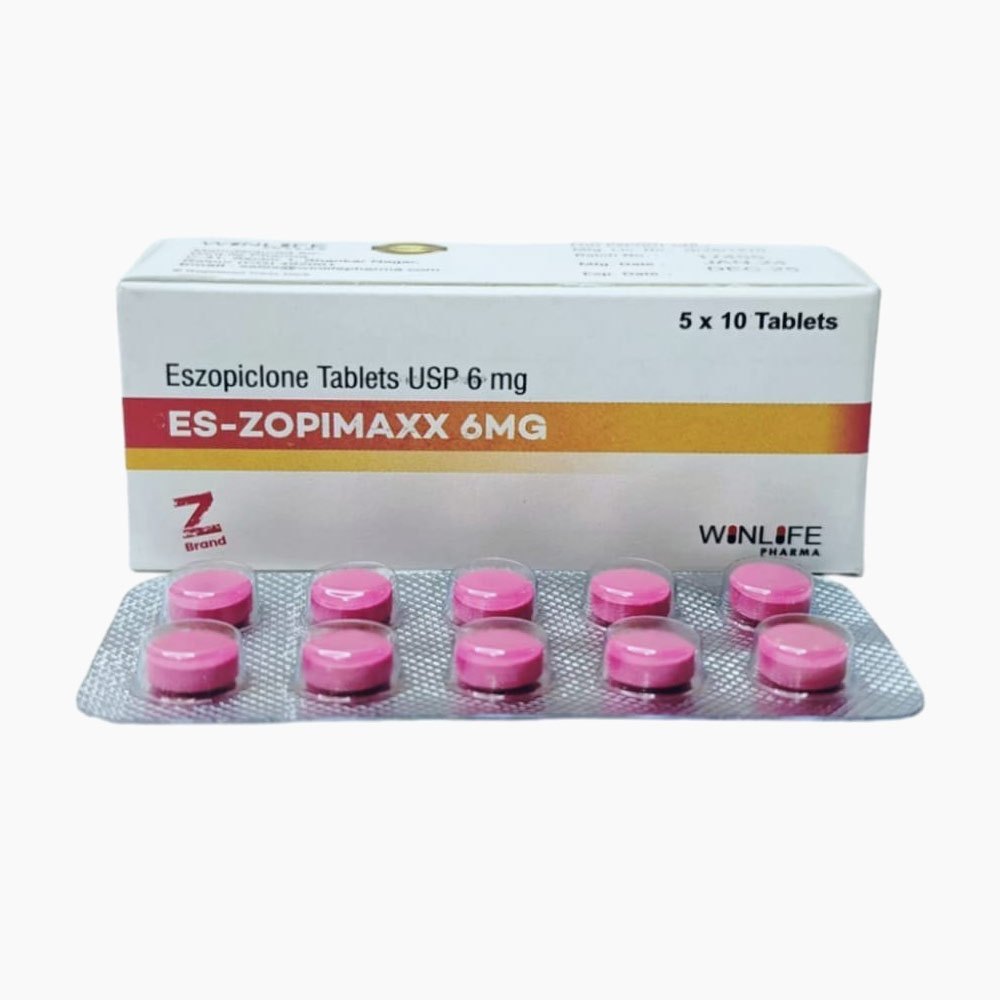
Description
No licensed eszopiclone 6mg tablet exists, and 6 mg is twice the highest nightly dose on the US label. Lunesta and its generics come in just three strengths (1, 2 and 3 mg), and the label caps a night at 3 mg (2 mg for some people).
This page is a pharmacist-style reality check. It walks through four made-up but realistic situations where “6 mg” shows up, explains why the label stops at 3 mg, and shows what to do instead when your current dose no longer seems to work.
Someone has already taken 6 mg or more?
Call 911 now if they cannot be woken, are breathing slowly or irregularly, have collapsed or have had a seizure. If the person is conscious and breathing steadily, phone Poison Help (1-800-222-1222), a free line open around the clock. Stay with them, keep them off the road and away from alcohol or any other sedating medicine, and have the bottle ready when you call. The federal Poison Help service connects you to your local poison center.
Case files: four ways “6 mg” ends up on the table
The scenarios below are hypothetical. They are built from the kinds of questions pharmacists hear at the counter, not from real patients. Each one shows a different route to the same number, and each needs a different fix.
Case file A (hypothetical): “Two of my 3s used to be one”
Dana, 44, has taken eszopiclone 3 mg most nights for eight months. It worked well at first. Lately she lies awake for an hour before it “kicks in.” One night she takes a second 3 mg tablet at 1 a.m. She sleeps, but she wakes groggy, misses a turn on the drive to work and cannot recall part of a phone call from the night before.
What went wrong. Dana treated a fading effect as a dosing problem. The label allows one dose a night, taken right before bed, and never more than 3 mg in total. Her second tablet went in late, so a large share of it was still active when her alarm rang. The memory gap and the slow reactions are exactly what the label warns about.
What to do. Skip driving that day. Call the prescriber, explain honestly what happened, and book a review of the whole treatment plan. Months of nightly use is a signal to talk about tapering and therapy, not a higher number. The section “When 3 mg isn’t enough anymore” below lays out that conversation.
Case file B (hypothetical): “My old pill was 6-point-something”
Marcus, 58, was switched from zolpidem extended-release 6.25 mg to eszopiclone. He remembered his old dose as “about 6,” assumed the new drug worked the same way, and asked whether he should take two 3 mg tablets to match.
What went wrong. Milligrams do not carry over between different drugs. Zolpidem ER 6.25 mg is a starting dose for that medicine. Eszopiclone is a different molecule with its own dose range, and 3 mg sits at the top of it. Matching the number would have doubled the eszopiclone ceiling.
What to do. Take the new medicine exactly as the new label on the bottle says. If the instructions are unclear, ask the dispensing pharmacist before the first dose. Never combine leftover zolpidem with eszopiclone on the same night. Our Ambien and Lunesta comparison explains how differently the two are dosed.
Case file C (hypothetical): “A website had a 6 mg pack”
Priya, 31, could not get an appointment quickly. She searched “lunesta 6mg” and found a site offering it with a short online form and no call from a prescriber. The listing promised a “stronger” version than her pharmacy carried.
What went wrong. No manufacturer makes this strength. A product sold as eszopiclone 6mg is mislabelled at best and counterfeit at worst. The site also skipped the prescription check that a Schedule IV medicine requires. Pills from sellers like this can contain the wrong drug, the wrong amount or something far more dangerous.
What to do. Do not order. If something already arrived, do not take it or share it; hand it in at a take-back site. Then get a proper appointment, even by telehealth with a licensed prescriber. The section on listings below covers the red flags.
Case file D (hypothetical): “Mom took two”
Leo checks on his mother, 79, and finds her very drowsy at 10 a.m. Her pill organizer shows two dark blue tablets missing from last night’s slot. She had an old 3 mg bottle from years ago as well as her current 1 mg prescription, and the bottles got mixed up.
What went wrong. For adults aged 65 and over, the label sets a ceiling of 2 mg. Two 3 mg tablets is three times that. Older adults also clear the drug more slowly, so it lingers longer. Old bottles kept “just in case” are a common source of this kind of mix-up.
What to do. If she is hard to rouse or her breathing seems slow or shallow, call 911. If she is awake and talking, call Poison Help and follow their advice. Help her move carefully, since a fall is a real danger. Afterwards, remove the old bottle and return it at a take-back site. Our page on medicines and older adults covers why fall risk rises with sedatives at that age.
The label ceiling for eszopiclone, and why it sits at 3 mg
The prescribing information for eszopiclone is short and firm on dose. Here is what it says, in plain terms. You can read the full Lunesta prescribing information on DailyMed.
- Starting point: 1 mg, taken right before bed.
- Possible increases: the prescriber may move to 2 mg or 3 mg if there is a clinical reason.
- Hard limit: 3 mg in total per night, taken once.
- Lower limit of 2 mg for: people who are elderly or frail, people with severe liver impairment, and anyone also taking a strong CYP3A4 inhibitor (the label names drugs such as ketoconazole, itraconazole, clarithromycin, ritonavir and nefazodone).
- Timing: only when you can stay in bed for a full 7 to 8 hours, and not with or straight after a heavy, high-fat meal, which slows absorption.
The licensed tablets match those steps: 1 mg (light blue, marked S190), 2 mg (white, S191) and 3 mg (dark blue, S193) on the brand version. Generic tablets look different but come in the same three strengths. If you have a current prescription, our pages on eszopiclone 1 mg, eszopiclone 2 mg and eszopiclone 3 mg cover each step of that ladder in more detail.
The 2014 decision that lowered the start
In May 2014, the FDA cut the recommended starting dose from 2 mg to 1 mg. A study in 91 healthy adults found that 3 mg taken at night impaired driving skills, memory and coordination the next morning. The effect peaked around 7.5 hours after the dose and was still potentially meaningful at 11.5 hours. Many volunteers did not feel impaired, which is the worrying part. The agency also found women and men equally affected. The FDA’s 2014 Lunesta safety communication lays out the findings.
Read that alongside the eszopiclone 6mg question. If 3 mg can blur the following morning without you noticing, double that amount takes the risk somewhere the studies never set out to measure as a treatment.
The 2019 boxed warning
In April 2019, the FDA added its strongest warning, a boxed warning, to eszopiclone, zolpidem and zaleplon. The trigger was complex sleep behaviors: sleepwalking, sleep-driving and other activities done while not fully awake. The agency counted 66 cases with serious injuries, 20 of them deaths, and noted these events happened even at the lowest recommended doses and sometimes after a single dose. Anyone who has had such an episode on one of these drugs should not be prescribed them again. See the FDA’s 2019 boxed warning announcement.
Two 3 mg tablets: what the body does with eszopiclone 6mg
This section explains risk. It is not dosing advice, and nothing here suggests 6 mg is ever a reasonable choice at home.
Exposure doubles
The label reports a study in healthy volunteers that gave doses from 1 mg up to 6 mg and found that blood levels rose in step with the dose. In other words, two 3 mg tablets put roughly twice as much drug in your bloodstream as one. There is no hidden cap that stops the extra amount from acting.
More drug is left when you wake
Eszopiclone has a half-life of about 6 hours in younger adults and about 9 hours in people 65 and over. After one half-life, half the dose is still in your system. Start with twice as much, and eight hours later you still carry about twice what a 3 mg dose would leave at the same point. The 2014 study had already found 3 mg alone impairing driving skills and memory at that hour. Taking the second tablet in the middle of the night makes this worse, because the clock starts later. Our guide to driving on sedating medicines explains why “I feel fine” is not a test you can trust.
The label’s own data on double doses
One part of the eszopiclone label speaks directly to this number. In an abuse-potential study, people with a past history of sedative misuse were given 6 mg and 12 mg. The drug produced euphoric effects similar to a high dose of diazepam. The label also reports more amnesia and hallucinations at doses of at least twice the maximum. So 6 mg is not just “a bit stronger.” It is the level where misuse-type effects and memory loss start to show up in the data.
Complex sleep behaviors
Sleep-driving, sleep-eating, cooking, making calls or leaving the house without being fully awake are the events behind the boxed warning. MedlinePlus notes that people often have no memory of them. Anything that deepens sedation while leaving the body able to move, including extra eszopiclone or alcohol, raises the stakes. If you or a family member notice any such episode, stop the drug and call the prescriber.
Breathing and the dangerous combinations
On its own, eszopiclone is less likely than older sedatives to stop someone breathing. The label notes that overdose deaths have occurred in combination with alcohol or other drugs that slow the brain. The highest-risk pairings are:
- Opioid painkillers, such as oxycodone, hydrocodone or codeine. Their effect on breathing adds to the sedation. Read more on combining opioids with sleep medicines.
- Alcohol, even a couple of drinks. Our page on how alcohol stacks with sedatives explains the mechanism.
- Benzodiazepines and other anxiety medicines that act on the same calming system. See our overview of common anti-anxiety medicines.
- Muscle relaxants and sedating antihistamines. Our guides on muscle relaxers and drowsiness and on why diphenhydramine adds sedation apply here too.
- Drugs that block CYP3A4, the liver enzyme that clears eszopiclone. Some antifungals and antibiotics raise its levels, which is why the label caps those patients at 2 mg. Our piece on how antifungals raise drug levels shows the same effect with another medicine.
People with sleep apnea, lung disease or liver disease have less margin for error. See sedatives and sleep apnea and how liver disease changes drug clearance for the reasons.
Where “eszopiclone 6mg” really comes from: other drugs’ numbers
Many searches for lunesta 6mg start with a real number from a different box. Several sleep medicines do have a 6 or 6.25 mg strength. The table lists the ones most often confused, with strengths taken from their current US labels.
| Medicine (brand) | Licensed US strengths | Where a “6” appears | Controlled? |
|---|---|---|---|
| Eszopiclone (Lunesta) | 1 mg, 2 mg, 3 mg | Nowhere. 6 mg would be twice the nightly limit | Yes, Schedule IV |
| Zolpidem extended-release (Ambien CR) | 6.25 mg, 12.5 mg | 6.25 mg is the starting dose for women and the dose for adults 65 and over | Yes, Schedule IV |
| Low-dose doxepin (Silenor) | 3 mg, 6 mg | 6 mg is the usual adult dose for trouble staying asleep | No |
| Suvorexant (Belsomra) | 5 mg, 10 mg, 15 mg, 20 mg | None, but its numbers are often misremembered alongside other sleep drugs | Yes, Schedule IV |
The Ambien CR label on DailyMed confirms the 6.25 mg tablet and its role as the lower starting dose. These medicines are not interchangeable milligram for milligram. A 6 mg doxepin tablet and a 3 mg eszopiclone tablet act on entirely different brain systems. For more side-by-side reading, see zopiclone vs Ambien and Ambien vs Sonata.
Zopiclone, the older parent drug sold outside the US, causes a similar mix-up with its own 7.5 mg tablet. We cover that in our page on why a 20 mg zopiclone tablet is a red flag.
Listings that sell eszopiclone 6mg, a strength that doesn’t exist
A product page offering eszopiclone 6mg tells you something important before you even look at the price: whoever made it is not working from a licensed label. Real manufacturers can only sell the strengths the FDA approved. A seller who invents a “stronger” option is either guessing, relabelling something else or counting on buyers not checking.
What can be inside
The DEA’s One Pill Can Kill campaign cautions that fake pills are mass-produced to look legitimate and that you cannot tell a real tablet from a fake by sight. Counterfeit sedatives sold online have turned up containing fentanyl and unapproved benzodiazepine-like chemicals. The DEA’s position is that the only safe pill is one your own clinician prescribed and a licensed pharmacy filled. Our page on flualprazolam vs alprazolam shows how designer sedatives get passed off as familiar brands.
How to check a seller
- A real pharmacy asks for a valid prescription from a licensed prescriber for any controlled medicine, including eszopiclone.
- It lists a physical US address and a licensed pharmacist you can speak to.
- It sells only strengths that appear on the FDA label: 1, 2 and 3 mg.
- It does not push bulk deals, “no questions” checkouts or payment by gift card or crypto.
The FDA’s BeSafeRx program explains how to tell a licensed online pharmacy from a fake one, including how to look up a pharmacy’s state license.
If a fake strength is already in your home
Do not taste it, split it or test it on yourself. Lock it away from children and visitors, following our tips on locking up controlled medicines, then take it to a pharmacy kiosk or a take-back event. Our guide to getting rid of unused medicines safely lists the options in order of preference. If anyone has swallowed some, use the emergency box near the start of this page.
When 3 mg isn’t enough anymore
This is the real story behind many searches for eszopiclone 6mg. The medicine worked, then it seemed to fade. A bigger dose looks like the obvious answer. It is not, and a good prescriber will want to hear about the fade instead.
MedlinePlus says sleep should begin to improve within 7 to 10 days of starting eszopiclone, and that you should call your doctor if it does not, or if it gets worse. That window is a useful benchmark. If you are months past it, the plan needs a fresh look.
Before the appointment
Spend a week keeping a simple sleep diary. Note when you went to bed, roughly how long it took to fall asleep, how often you woke, and when you got up. Add caffeine, alcohol, naps, screen time, pain and stress. Write down every medicine and supplement you take, including over-the-counter sleep aids and melatonin. Our page on mixing melatonin with other sedatives explains why that matters.
Questions to bring
- “I have been on 3 mg for this long. Is the drug still the right tool, or has my body adapted?”
- “Could something else be keeping me awake, such as sleep apnea, restless legs, pain, low mood or a thyroid problem?”
- “Do any of my other medicines interact with eszopiclone or affect sleep?”
- “If we reduce or stop it, what will the taper look like, and what should I expect on rough nights?”
- “Can you refer me for CBT-I, or point me to a program I can start now?”
- “What should I do if I ever have a sleepwalking or memory-gap episode?”
If you find these talks awkward, our guide to raising medicine concerns with your doctor has tips that work for any prescription.
Why CBT-I comes up
Cognitive behavioral therapy for insomnia (CBT-I) is a structured, short course that retrains sleep habits and the anxious thinking that keeps people awake. The American Academy of Sleep Medicine gives it a strong recommendation as the treatment of choice for chronic insomnia in adults, in its clinical practice guideline on behavioral treatments. Its gains tend to hold up after the course ends. It is offered in person, by video and through digital programs, and it can start while you are still taking a sleep medicine.
Don’t quit overnight either
Stopping suddenly after long, regular use can bring rebound insomnia and withdrawal symptoms such as anxiety, shakiness, nausea and sweating, and in rare cases seizures. Your prescriber can plan a gradual step-down. Pair it with steady habits: a fixed wake-up time, light in the morning, caffeine only early in the day and a calm wind-down. Our list of gentle ways to support deeper sleep has more ideas.
Sleep problems and low mood often travel together. The eszopiclone label warns that sedatives can worsen depression in some people. If you notice darker thoughts, tell your prescriber. If you are thinking about harming yourself, call or text 988 for free, round-the-clock support. Our article on medicines and depression describes warning signs to watch for.
Pharmacist’s bottom line: the answer to “3 mg stopped working” is a review, not a second tablet. Bring your sleep diary and your medicine list, and ask about CBT-I and a taper plan.
Household checks that prevent a double dose
Two of our four case files came from mix-ups at home, not choices. A few habits remove most of that risk.
- Keep only the current strength. When a dose changes, return the old bottle rather than saving it.
- Store eszopiclone in its labelled bottle, in a locked box, away from the nightstand where a half-asleep hand can reach a second dose.
- If someone else manages pills for an older relative, use one organizer and check it against the bottle label each week.
- Agree a household rule: no tablet after midnight, and no extra tablet if sleep does not come.
Our room-by-room family medicine safety checklist adapts easily to sleeping pills.
Frequently asked questions
Is there a 6 mg Lunesta tablet?
No. Lunesta and generic eszopiclone are approved only as 1, 2 and 3 mg tablets. Any product sold as Lunesta 6mg is not an FDA-approved medicine and may be counterfeit.
What is the maximum dose of eszopiclone?
The label sets 3 mg per night, taken once, as the limit for most adults. It drops to 2 mg for older or frail adults, people with severe liver impairment and people taking strong CYP3A4 inhibitors. Your prescriber chooses where you sit within that range.
Can I take two 3 mg eszopiclone tablets?
No. That would be 6 mg, twice the label maximum. It roughly doubles drug levels, raises the risk of next-day impairment, memory gaps and complex sleep behaviors, and is far more dangerous with alcohol or opioids.
What happens if you take too much Lunesta?
Expect heavy drowsiness and confusion; at higher amounts, coma is possible. The label notes deaths have occurred when an overdose was combined with alcohol or other sedating drugs. If the person won’t wake or is struggling to breathe, call 911; otherwise phone Poison Help on 1-800-222-1222.
Why is my Lunesta not working anymore?
Possible reasons include the body adapting after long use, new stress or pain, caffeine or alcohol, a heavy meal near bedtime, or an untreated sleep disorder. Book a review with your prescriber rather than raising the dose yourself.
How long does eszopiclone stay in your system?
Its half-life is about 6 hours in younger adults and about 9 hours in people 65 and over. The FDA found next-day effects from 3 mg lasting up to 11.5 hours in some people, and a larger dose stretches that further.
Is eszopiclone a controlled substance?
Yes. It is a federal Schedule IV controlled substance and needs a valid prescription from a licensed prescriber. Legitimate pharmacies will not dispense it without one.
Is eszopiclone 6mg the same as doxepin 6 mg?
No. Low-dose doxepin (Silenor) is a different medicine that genuinely comes in 6 mg for trouble staying asleep. It is not a controlled substance and works on a different brain pathway. The numbers are unrelated.
Can I take eszopiclone in the middle of the night if I wake up?
The label says to take it once, right before bed, and only when you can stay in bed for 7 to 8 hours. A late dose leaves more drug active in the morning. If waking at night is your main problem, raise it with your prescriber.
Is eszopiclone the same as zopiclone?
They are closely related. Eszopiclone is one half of the zopiclone molecule and is the version approved in the US. Zopiclone is sold in the UK, Canada and elsewhere in different strengths, so doses do not transfer between them.
Key takeaways
- Eszopiclone 6mg is not a licensed strength. Real tablets are 1 mg, 2 mg and 3 mg.
- The label caps a night at 3 mg, or 2 mg for older adults, severe liver impairment and strong CYP3A4 inhibitors.
- Two 3 mg tablets roughly double exposure, and the label links doses of twice the maximum to more amnesia and hallucinations.
- Most “6” numbers come from other drugs, such as zolpidem ER 6.25 mg or doxepin 6 mg, and milligrams don’t transfer between medicines.
- A website selling a 6 mg strength is a counterfeit warning sign.
- If 3 mg stops helping, ask for a review, CBT-I and a taper plan, never a bigger dose.
- Emergency: call 911 if someone won’t wake or breathes poorly; Poison Help is 1-800-222-1222; call or text 988 in a crisis.
This description is for information only and does not replace advice from your doctor or pharmacist. Use only as prescribed.


Reviews
There are no reviews yet.