
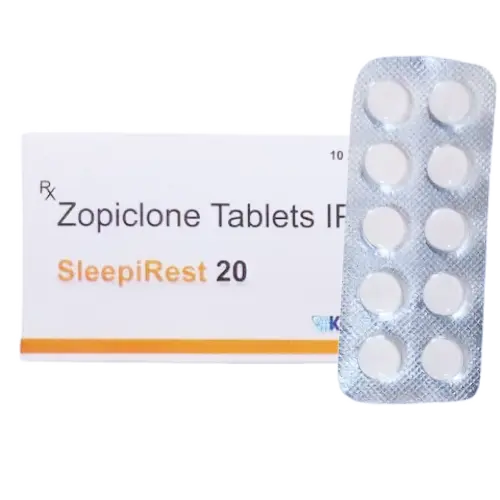
Description
If you searched for zopiclone 20mg, here is the short answer: no regulator we checked lists a 20 mg zopiclone tablet, and 20 mg is well above any licensed nightly dose. This page explains which strengths really exist, why a “20 mg” label is a warning sign, and what to do if you have taken more zopiclone than you were prescribed.
The verdict at a glance
| Question | Answer |
|---|---|
| Is there a zopiclone 20 mg tablet? | Not as a licensed product in the markets we checked (UK, Canada, EU labels). Japan has listed a 10 mg tablet; nothing higher. |
| What strengths do exist? | 3.75 mg and 7.5 mg (UK and much of Europe); 3.75 mg, 5 mg and 7.5 mg (Canada). |
| What is the usual maximum for one night? | 7.5 mg for adults, taken once, just before bed. |
| How does 20 mg compare? | About 2.7 times the adult maximum and more than 5 times the 3.75 mg starting dose used for older adults. |
| Is zopiclone sold in US pharmacies? | No. It is not FDA-approved and is a federally controlled (Schedule IV) substance. Its close relative, eszopiclone (Lunesta), is the US option. |
| What should I do with a pill marked “20 mg”? | Do not take it. Treat it as possibly counterfeit and take it to a pharmacy or a drug take-back point. |
Where the real strengths come from
Every licensed medicine has an official label: the Summary of Product Characteristics (SmPC) in the UK and Europe, and the Product Monograph in Canada. These documents list each strength the manufacturer is allowed to sell. When you look across them, a clear pattern appears.
| Market | Licensed tablet strengths | Usual adult dose | Lower starting dose for |
|---|---|---|---|
| United Kingdom | 3.75 mg, 7.5 mg | 7.5 mg at bedtime | Older adults, liver problems, kidney problems, chronic breathing problems (3.75 mg) |
| Canada | 3.75 mg, 5 mg, 7.5 mg | Start at 3.75 mg; 7.5 mg is the ceiling | All adults start low since Health Canada’s 2014 change |
| Japan | 7.5 mg, 10 mg | Per local label | Per local label |
| United States | None (not FDA-approved) | Not applicable | Eszopiclone 1 mg is the usual US starting dose |
The UK label states that the recommended adult dose is one 7.5 mg tablet (or two 3.75 mg tablets) taken shortly before going to bed, and it sets 3.75 mg as the starting point for older adults and for people with liver, kidney or chronic breathing problems. You can read the full text in the UK Summary of Product Characteristics for zopiclone 7.5 mg.
Canada went further. In 2014, Health Canada lowered its recommendations after evidence that next-day impairment could last up to 11 hours after an evening dose. Canadian adults now start at 3.75 mg, and 7.5 mg is the dose not to exceed. The British Columbia PharmaCare bulletin on zopiclone dosing summarises those rules and the tablet strengths sold there.
Across these labels, nothing approaches 20 mg. If you have seen “zopiclone 20mg” on a website, a strip of tablets or a social media post, the label itself is the first red flag.
The arithmetic of 20 mg
Numbers make the gap easier to see. The table below compares 20 mg with the doses the labels actually use. It is not a dosing guide; it shows how far outside normal use a 20 mg amount sits.
| Reference dose | Who it applies to | 20 mg is roughly… |
|---|---|---|
| 3.75 mg | Starting dose for older adults and people with liver, kidney or breathing problems; all-adult starting dose in Canada | 5.3 times higher |
| 5 mg | Middle Canadian strength | 4 times higher |
| 7.5 mg | Usual adult maximum for one night | 2.7 times higher |
| 10 mg | Highest tablet listed in any market we found (Japan) | 2 times higher |
Zopiclone also lingers. Its half-life is around five hours in healthy adults and longer in older people and in those with liver disease. Taking more does not just deepen sleep; it stretches the time the drug stays active well into the next day.
Why does “zopiclone 20mg” get searched at all?
People land on this question for different reasons. Working out which one applies to you points to the right next step.
1. A mix-up with another sleeping or anxiety medicine
Several common medicines do come in 20 mg. Temazepam, a benzodiazepine sleeping pill, is sold as 10 mg and 20 mg tablets in the UK. Many antidepressants, such as citalopram and fluoxetine, come in 20 mg. Zolpidem (Ambien) comes in 5 mg and 10 mg. It is easy to carry a number from one box to another in your memory. If you are unsure, read the label on your actual pack or ask your pharmacist. Our comparisons of zopiclone and Ambien and of Halcion and Ativan show how differently these drugs are dosed.
2. Adding tablets together
Some people ask about 20 mg because they are thinking of taking two or three tablets at once. The labels are clear: one dose per night, and no second dose if you wake up. A second tablet does not “top up” the first. It raises the risk of confusion, falls and slowed breathing, and it pushes impairment into the morning.
3. The usual dose has stopped working
Zopiclone is meant for short courses, usually a few days to a few weeks. After that the brain adapts, and the same dose feels weaker. This is tolerance, and the answer is not a bigger tablet. We explain what to do instead in the section on when 7.5 mg stops working.
4. An online listing
Unlicensed websites sometimes advertise strengths that no manufacturer makes. A “20 mg” listing is a strong sign that the product is counterfeit, mislabelled or made without quality control. The section on spotting fake tablets covers this.
5. Worry after someone has already taken it
If you are reading this because someone has already swallowed a large amount, use the emergency box at the top of the page first. Read the rest later.
What higher amounts of zopiclone do to the body
Zopiclone belongs to the “Z-drug” group. Like benzodiazepines, it boosts the effect of GABA, the brain’s main calming signal. At the right dose this shortens the time it takes to fall asleep. Above that dose, the same calming signal spreads to systems you need to stay safe.
| Body system | What changes as the amount rises | Why it matters |
|---|---|---|
| Alertness | Heavy sedation, difficulty waking, confusion on waking | A person may not respond to an alarm, a smoke detector or a crying child |
| Breathing | Slower, shallower breathing; snoring that sounds different | Much more dangerous with alcohol, opioids, sleep apnoea or lung disease |
| Balance | Unsteady walking, poor coordination | Falls and hip fractures, especially in older adults at night |
| Memory | Gaps in memory for the hours after the dose | People may not remember calls, messages or actions |
| Behaviour during sleep | Sleepwalking, sleep-eating, sleep-driving | Rare but serious injuries and deaths are on record across this drug class |
| Next day | Grogginess, slow reactions, poor judgement | Driving or operating machinery becomes unsafe |
The NHS advises against driving, cycling or using machinery for 12 hours after a normal dose of zopiclone. At higher amounts that window stretches further. The NHS also lists difficulty breathing and sleepwalking among the possible serious side effects. See the NHS guide to zopiclone for its full list.
In the US, the FDA added a boxed warning in April 2019 to eszopiclone, zaleplon and zolpidem after reports of serious injuries and deaths linked to complex sleep behaviours. Zopiclone was not part of that action because it is not sold in the US, but eszopiclone is its closer chemical relative. The FDA’s 2019 safety communication explains the warning.
The combinations that turn a high dose into an emergency
Most serious zopiclone overdoses involve something else as well. Two depressants together do more harm than either one alone. These are the combinations that matter most.
| Taken with zopiclone | What happens | Learn more |
|---|---|---|
| Alcohol | Deeper sedation and slower breathing; the NHS says not to drink while taking zopiclone | How alcohol stacks with sedating medicines |
| Opioid painkillers (oxycodone, codeine, morphine) | Combined breathing depression; one of the most dangerous pairings | Opioids and sleep medications |
| Benzodiazepines (diazepam, alprazolam, clonazepam) | Same brain target, so effects add up | Klonopin vs Valium |
| Sedating antihistamines (diphenhydramine, promethazine) | Extra drowsiness and confusion | Why Benadryl adds sedation |
| Gabapentin or pregabalin | Added sedation and breathing risk | Gabapentin and other medicines |
| Muscle relaxants | More drowsiness and unsteadiness | Muscle relaxers and sedation |
| Some antibiotics and antifungals (clarithromycin, erythromycin, itraconazole, ketoconazole) | Slow the liver’s CYP3A4 enzyme, so zopiclone builds up | How antifungals raise drug levels |
| Melatonin or herbal sleep aids | Usually milder, but still adds to sleepiness | Melatonin with other sedatives |
Some medicines push zopiclone levels the other way. Rifampicin, carbamazepine, phenytoin and St John’s wort speed up its breakdown, which can make a normal dose feel weak. That is one reason people are tempted to take more, and it is why any change in effect should go back to the prescriber, not into a larger dose.
Who is most at risk from a large dose
Some bodies clear zopiclone more slowly or cope less well with sedation. For these groups, even amounts below 20 mg can cause harm.
- Adults over 65. They clear the drug more slowly and are more likely to fall at night. Labels start them at 12.5 mg. Our guide to medicines and older patients covers fall risk in more depth.
- People with liver disease. The liver does most of the work of breaking zopiclone down. Severe liver failure is a reason not to use it at all. See how liver disease changes drug handling.
- People with sleep apnoea. Sedatives relax throat muscles and blunt the urge to breathe. Read more in sedating medicines and sleep apnoea.
- People with COPD or other chronic lung problems. Their reserve for slowed breathing is small. See sedatives and COPD.
- People with myasthenia gravis. Zopiclone can worsen muscle weakness.
- Anyone with a history of drug or alcohol dependence. The NHS notes that zopiclone may not be suitable for them.
- Anyone who is pregnant or breastfeeding. Zopiclone is not usually used in pregnancy. While breastfeeding, the NHS warns against sharing a bed with a baby after taking any sleeping medicine.
Spotting fake or mislabelled “zopiclone” tablets
A strength that does not exist is the easiest clue, but it is not the only one. Counterfeit sedatives are a real and growing problem. The DEA’s One Pill Can Kill campaign warns that you cannot judge a pill by looking at it, and that the only safe medicines are those prescribed by a clinician and dispensed by a licensed pharmacist. Fake tablets sold as sleeping pills or anxiety pills have been found to contain unexpected drugs, including potent opioids and unapproved benzodiazepine-like chemicals of the kind we describe in flualprazolam vs alprazolam and etizolam vs alprazolam.
Warning signs on the product
- A strength that does not appear on any official label, such as 15 mg, 20 mg or 25 mg.
- No printed patient leaflet, or a leaflet with spelling mistakes or missing sections.
- Loose tablets, unmarked strips or a pack with no batch number or expiry date.
- Tablets that differ in colour, size or markings from one pack to the next.
Warning signs on the seller
- No prescription required, or a “consultation” that is only a quick online form.
- No physical address, no named pharmacist and no way to speak to a pharmacist.
- Prices far below normal, bulk discounts on controlled medicines, or payment only by cryptocurrency or gift card.
- Promises of discreet shipping across borders for a drug that is controlled where you live.
The FDA’s BeSafeRx guide explains how to check whether an online pharmacy is licensed, and the DEA keeps a page on illegal online pharmacies.
If you already have tablets labelled 20 mg
- Do not take them, split them or give them to anyone else.
- Keep them away from children and pets in a locked box. Our safe storage guide describes lockbox options that work for any controlled medicine.
- Take them to a pharmacy or a drug take-back point. The FDA’s disposal page lists the options, and our guide to disposing of unused medicines walks through each one.
- If you have taken any and feel unwell, follow the emergency steps at the top of this page.
Zopiclone and the US: what the law says
Zopiclone has never been approved by the FDA. Federally it is a Schedule IV controlled substance, the same schedule as many benzodiazepines and Z-drugs. That means US pharmacies do not stock it, and buying it from abroad carries legal risk on top of the quality risk described above.
The US-approved relative is eszopiclone, sold as Lunesta and as generics. It contains the active half of the zopiclone molecule and comes in 1 mg, 2 mg and 3 mg tablets. In 2014 the FDA lowered its recommended starting dose to 1 mg because of next-morning impairment. If you are in the US and your doctor thinks a Z-drug is right for you, eszopiclone is the legal, regulated route. Our Ambien vs Lunesta comparison explains how the two US options differ, and Ambien vs Sonata covers the shortest-acting choice.
When 25 mg stops working: what to do instead of taking more
This is the situation behind many “20 mg” searches. You were sleeping well on a normal dose, and now you are not. Taking a larger amount feels like the obvious fix, but it usually makes things worse within days. Here is a better order of steps.
Step 1: Check what has changed
New medicines, a new antibiotic course, more alcohol, more caffeine late in the day, a change in shift pattern, pain that wakes you, or a new worry can all disrupt sleep. Write down what has changed in the last few weeks before you see your doctor.
Step 2: Talk to your prescriber about the length of treatment
Labels in the UK and Canada intend zopiclone for short-term use: the NHS says it is not usually prescribed for more than four weeks, and Canadian monographs say courses usually should not exceed 7 to 10 consecutive days. If you have been taking it for longer, the dose “not working” is expected. Your prescriber can plan the next stage with you.
Step 3: Do not stop suddenly
After regular use, stopping all at once can bring rebound insomnia, anxiety and agitation. The NHS advises that your doctor reduce the dose gradually. A slow taper is safer and usually more comfortable. Our article on sleeping during withdrawal has practical tips for rough nights, many of which apply here.
Step 4: Ask about CBT for insomnia
Cognitive behavioural therapy for insomnia (CBT-I) is the first-line treatment recommended by major sleep guidelines. It works on the habits and thoughts that keep insomnia going, and its benefits tend to last after treatment ends, which sleeping pills cannot match. It is available in person, by phone and through approved apps.
Step 5: Look for treatable causes
Persistent insomnia is sometimes a symptom of something else: sleep apnoea, restless legs, an overactive thyroid, depression, anxiety or chronic pain. Treating the cause can fix sleep better than any sedative. If anxiety is part of the picture, our overview of anti-anxiety medicines explains the options your doctor may discuss, and clonazepam vs alprazolam shows why benzodiazepines are not a simple swap.
Step 6: Build a sleep routine that supports the treatment
- Keep the same wake-up time every day, including weekends.
- Go to bed only when sleepy, and get up if you have been awake in bed for a long stretch.
- Stop caffeine by early afternoon and avoid alcohol as a sleep aid.
- Keep the bedroom dark, cool and quiet, and put screens away an hour before bed.
- Use daylight in the morning to anchor your body clock.
For more ideas, see our guides to natural remedies for deeper sleep and self-care rituals for mental wellness.
A side-by-side look at the sleep medicines people confuse with “20 mg”
| Medicine | Class | Common tablet strengths | US status |
|---|---|---|---|
| Zopiclone | Z-drug | 12.5 mg, 5 mg, 25 mg (10 mg in Japan) | Not approved; Schedule IV |
| Eszopiclone (Lunesta) | Z-drug | 1 mg, 2 mg, 3 mg | Approved; Schedule IV |
| Zolpidem (Ambien) | Z-drug | 5 mg, 10 mg (extended-release 6.25 mg, 12.5 mg) | Approved; Schedule IV |
| Zaleplon (Sonata) | Z-drug | 5 mg, 10 mg capsules | Approved; Schedule IV |
| Temazepam | Benzodiazepine | 10 mg, 20 mg (UK tablets); 7.5–30 mg capsules (US) | Approved; Schedule IV |
The point of this table is simple: a “20 mg” figure belongs to other medicines, not to zopiclone. If a pack in your cupboard says 20 mg, check the drug name carefully. Our Ambien vs Ativan article is a useful example of how two sedatives with different strengths are not interchangeable.
If you took more than prescribed: what happens next
Knowing what to expect can make a stressful call easier.
- The call. Poison Help (US) or NHS 111 (UK) will ask what was taken, how much, when, the person’s age and weight, and whether alcohol or other medicines were involved. Have the packet in your hand. Poison Help is free and open 24 hours a day.
- Watching at home or going to hospital. Depending on the amount and the person’s health, you may be told to watch them closely at home or to go to an emergency department. If you go, do not drive yourself; ask someone else or call for an ambulance, as the NHS advises.
- In hospital. Treatment is mainly supportive: monitoring breathing, oxygen levels and heart rhythm until the drug wears off. Activated charcoal may be used soon after a large ingestion. In serious cases, doctors may use flumazenil, a medicine that can temporarily reverse benzodiazepine-like sedation. Its effect is shorter than zopiclone’s, so people are still observed.
- If opioids are involved. Naloxone reverses opioid overdose but does not reverse zopiclone. If you have naloxone and suspect opioids were taken too, give it and call 911. Our page on signs an opioid dose is too high lists the breathing signs to watch for.
- Afterwards. A follow-up with the prescriber matters. Many overdoses are accidental, but if the overdose was deliberate, or if you are having thoughts of harming yourself, call or text 988 in the US or contact NHS 111 or Samaritans (116 123) in the UK.
Keeping zopiclone safe at home
Overdoses are not always the person with the prescription. Children, teenagers, visitors and pets can find tablets left on a nightstand.
- Store tablets in a locked box, not in a handbag or bedside drawer.
- Count tablets when you collect a prescription and check the count weekly.
- Never decant tablets into unlabelled containers or pill organisers that others might use.
- Do not share your prescription, even with someone who “has the same problem”.
- Clear out leftover tablets once a course ends.
Our guide to family safety around controlled medicines has a room-by-room checklist you can adapt for sleeping pills.
Driving and work after zopiclone
Next-day impairment is one of the main reasons regulators lowered Z-drug doses. You can feel awake and still react slowly. With a normal dose, the NHS advises waiting 12 hours before driving, cycling or using machinery, and longer if you still feel sleepy or dazed. A larger dose extends that time in ways that are hard to predict. Our article on driving on sedating medicines explains how impairment is judged and why “feeling fine” is not a reliable test.
Where to read about zopiclone at normal doses
This page focuses on the 20 mg question. For full information about the licensed strength, including the dose ladder for different patient groups, side effects, interactions and how to stop safely, see our zopiclone 7.5 mg information page.
Frequently asked questions
Is there a 20 mg zopiclone tablet?
No licensed 20 mg tablet appears in the UK, Canadian or EU labels we checked. The highest tablet we found anywhere is 10 mg, listed in Japan. Products labelled 20 mg should be treated as possibly counterfeit.
What is the maximum dose of zopiclone in one night?
For adults, 25 mg taken once at bedtime. Older adults and people with liver, kidney or chronic breathing problems usually start at 12.5 mg. In Canada, all adults start at 12.5 mg.
Can I take two 25 mg zopiclone tablets?
No, not unless a specialist has specifically told you to, which would be very unusual. The labels allow one dose per night. Two tablets double the amount without doubling the sleep, and they raise the risk of breathing problems, falls and next-day impairment.
Is 15 mg of zopiclone dangerous?
15 mg is twice the adult maximum. It is more likely to cause heavy sedation, confusion and memory gaps, and it is much more dangerous with alcohol or opioids. If someone has taken that much, call Poison Help or NHS 111 for advice.
What happens if you take too much zopiclone?
Effects range from deep drowsiness and confusion to unsteady walking, slowed breathing and, in severe cases, coma. Deaths have been reported, mostly when zopiclone was combined with alcohol, opioids or other sedatives. Hospital treatment is mainly supportive monitoring.
Why is my zopiclone not working anymore?
The most common reason is tolerance after more than a few weeks of use. Other causes include new medicines that speed up its breakdown, alcohol, caffeine, pain or an untreated sleep disorder. Talk to your prescriber rather than increasing the dose.
Is zopiclone legal in the US?
Zopiclone is not FDA-approved and is a federal Schedule IV controlled substance. US pharmacies do not dispense it. Eszopiclone (Lunesta) is the approved US relative.
Does a bitter taste mean I took too much?
No. A bitter or metallic taste is a common side effect even at normal doses. It is not a sign of overdose, though it may last longer after a larger amount.
Can I cut a “20 mg” tablet into smaller pieces to get a normal dose?
No. If the product is not licensed, you cannot know what it contains or how evenly the drug is spread through the tablet. Splitting it does not make it safe. Dispose of it and get a licensed prescription.
How long does zopiclone stay in the body?
Its half-life is about five hours in healthy adults, so most of a dose is cleared within a day. It lasts longer in older adults and in people with liver disease, and a larger amount takes longer to clear.
Key takeaways
- There is no licensed zopiclone 20 mg tablet in the markets we checked; real strengths are 12.5 mg, 5 mg and 25 mg, with 10 mg in Japan.
- 25 mg once at bedtime is the usual adult maximum. 20 mg is about 2.7 times that.
- A “20 mg” label is a sign the product may be unsafe.
- Most serious overdoses involve alcohol, opioids or other sedatives as well.
- If the usual dose stops working, talk to your prescriber about tapering and CBT-I; do not raise the dose yourself.
- If someone has taken too much: 911 for breathing or waking problems, Poison Help at 1-800-222-1222 for advice.
This page is for general information and is not a substitute for advice from your doctor or pharmacist. Never change your dose without speaking to your prescriber.
If you or someone else has already taken more than the prescribed dose:
- If the person is hard to wake, breathing slowly or noisily, or has blue or grey lips: call 911 (UK: 999) now.
- If they are awake and breathing normally: call Poison Help at 1-800-222-1222 (US) or NHS 111 (UK) for advice.
- Do not let them drive, drink alcohol or take any other sleeping pill, painkiller or anxiety medicine.
- Keep the packet or tablets so the medical team can see what was taken.



Reviews
There are no reviews yet.