
Description
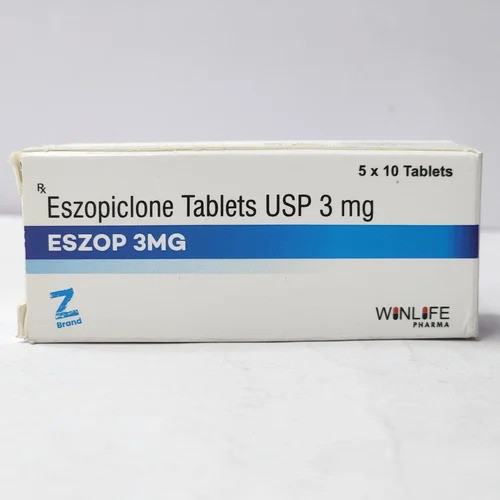
Prescription only · Schedule IV controlled substance · This is the ceiling dose. Eszopiclone 3mg is the highest strength on the US label. The label says the total dose should not go above 3 mg once a night, taken right before bed. It is not a starting dose: the label starts adults at 1 mg. Older or debilitated adults, people with severe liver impairment, and people taking strong CYP3A4 inhibitors are capped at 2 mg. Your prescriber decides whether 3 mg is right for you.
Eszopiclone 3mg is the top labeled strength of eszopiclone, the generic name for Lunesta. It treats insomnia, meaning trouble falling asleep, trouble staying asleep, or both. This page reads like a data sheet. We set out the numbers from the FDA-approved label. Then we explain what the clinical trials actually measured and what the FDA found about next-day impairment at this dose in 2014. Finally, we decode the warnings the way a pharmacist would. If you have been prescribed the 3 mg tablet, you should know what sits behind that number.
Eszopiclone 3mg spec sheet: the label in one table
Every value below comes from the US prescribing information for Lunesta and its generic versions. You can check the Lunesta prescribing information on the FDA website or a generic eszopiclone label on DailyMed. Tablet colors and imprints differ between makers, so always compare your tablet with your own pharmacy label.
| Field | Value | What it means for you |
|---|---|---|
| Generic / brand | Eszopiclone / Lunesta | Generic tablets contain the same active drug as the brand. |
| Strength | 3 mg film-coated tablet | The highest of three US strengths (1 mg, 2 mg, 3 mg). |
| Drug class | Non-benzodiazepine sedative-hypnotic | Often grouped with zolpidem and zaleplon as a “Z-drug”. It acts on GABA-A receptors in the brain. |
| Time to peak level (Tmax) | About 1 hour | It works fast, which is why the label says to take it only right before bed. |
| Half-life | About 6 hours (about 9 hours at 65+) | Some drug is still in your blood the next morning. This is why next-day impairment matters. |
| Metabolism | Liver enzymes CYP3A4 and CYP2E1 | Medicines that block CYP3A4 can raise eszopiclone levels. |
| Food effect | A heavy, high-fat meal slows absorption | The label says not to take it with or just after such a meal, as sleep onset may be slower. |
| Labeled dose range | Start 1 mg; may increase to 2 mg or 3 mg; never above 3 mg | 3 mg is the ceiling, not the default. |
| Federal schedule | DEA Schedule IV | Prescription only, with limits on refills. It carries a recognised risk of misuse and dependence. |
| First US approval | December 2004 (NDA 021476) | The drug has about two decades of US use and post-marketing safety data. |
| Boxed warning | Complex sleep behaviors (added 2019) | Sleep-walking, sleep-driving and other acts while not fully awake. See the decoder below. |
One practical point from the label: take this medicine only if you can stay in bed for a full night of 7 to 8 hours. A fast onset and a 6-hour half-life together mean that a 3 mg dose taken late, or taken in the middle of the night, leaves a lot of drug on board when your alarm goes off. If you are curious how half-life works as a general idea, our plain-language guide to drug half-life and how long a medicine stays active walks through the arithmetic.
What the trials measured (and what they did not)
Here is what the label’s clinical studies section actually describes, in plain words. Eszopiclone was tested in six placebo-controlled trials lasting up to 6 months. These enrolled about 2,100 people aged 18 to 86, including over 500 older adults in two dedicated trials.
The outcomes researchers tracked
- Sleep latency: how long it takes to fall asleep. Some trials measured this in a sleep lab with brain-wave recordings (polysomnography). Others used patient diaries.
- Sleep maintenance: how much time a person spends awake after first falling asleep, and total sleep time.
- Latency to persistent sleep: the lab-measured time until steady, unbroken sleep begins.
The trial designs, decoded
- A single-night study in healthy adults looked at short-term (transient) insomnia in a sleep lab.
- A 6-week adult study used objective sleep-lab measures for chronic insomnia.
- A 6-month adult study relied on patient-reported measures (diaries and questionnaires). It is the main reason eszopiclone was not given a short-term-only label in the US.
- Two 2-week studies enrolled adults aged 65 and over. They are the basis for the lower 2 mg cap in older people.
How to read that evidence
Three caveats are worth keeping in mind. First, the 6-month study measured how people felt they slept, not lab-recorded sleep. Patient reports are meaningful, but they are softer data. Second, the trials were built to show benefit against placebo. They were not built to prove that 3 mg works better than 2 mg in every person. Third, the trials did not fully capture next-day driving and memory effects at 3 mg. That gap was the reason for the later FDA study described in the next section. The label supports eszopiclone for insomnia; it does not say more is always better.
The label also notes that insomnia that has not improved after 7 to 10 days of treatment may point to an underlying condition. Examples include depression, an anxiety disorder or a breathing problem during sleep. That is a reason for a fresh review, not an automatic step up to 3 mg.
The impairment question: what the FDA found about eszopiclone 3mg
In May 2014 the FDA published a drug safety communication on next-day impairment with Lunesta. It changed how the 3 mg tablet is used. Here is what that study did and found, in our own words.
| Study element | Detail (per FDA, May 2014) |
|---|---|
| Who took part | 91 healthy adults aged 25 to 40 |
| Design | Double-blind, eszopiclone 3 mg compared with placebo |
| When testing happened | The next morning, between 7.5 and 11.5 hours after the bedtime dose |
| What was tested | Driving-related coordination, working memory and self-rated sleepiness |
| Main finding | Impairment of coordination and memory was greatest at 7.5 hours. It could still be clinically meaningful at 11.5 hours. |
| The hidden part | People often did not notice they were impaired. Their own ratings did not reliably differ from placebo. |
| Size of effect | Almost as large as the effect of zopiclone 7.5 mg, a related drug used in other countries |
As a result, the FDA cut the recommended starting dose from 2 mg to 1 mg for both men and women. It kept 3 mg as the maximum, to be reached only if needed. That is the key context for this product: eszopiclone 3mg is a dose a prescriber steps up to, not one a new patient begins with. If you are early in treatment, our eszopiclone 1 mg first-week guide covers the starting dose.
If you already take 3 mg: the FDA advice was not to stop on your own. Keep taking your prescribed dose, but talk to your prescriber about whether 3 mg is still the right amount. On the day after a 3 mg dose, avoid driving and other tasks that need full alertness, even if you feel fine. Feeling awake is not proof that you are unimpaired. Our guide to driving safely on sedating prescription medicines explains why self-assessment is unreliable.
Memory effects are part of the same picture. If next-morning fogginess or forgetfulness is something you notice, the general advice in our article on medicines that affect memory and what to tell your doctor applies here too.
Who the label keeps below 3 mg
The label sets a hard 2 mg cap for three groups. In each case, the reason is higher blood levels of eszopiclone for the same tablet.
| Group | Label cap | Why |
|---|---|---|
| Elderly or debilitated adults | 2 mg | At age 65 and over, total exposure was about 41% higher and the half-life about 9 hours. Older adults also face a higher risk of falls at night. |
| Severe liver impairment | 2 mg | Exposure roughly doubled in severe hepatic impairment, because the liver clears the drug. |
| Taking a strong CYP3A4 inhibitor | 2 mg | Drugs that block CYP3A4 slow clearance. The label names potent inhibitors such as ketoconazole as an example class. |
Common strong CYP3A4 inhibitors include some azole antifungals, some macrolide antibiotics and some HIV medicines. Grapefruit products can also affect this enzyme. Our article on how azole antifungals raise levels of CYP3A4-processed drugs shows the same mechanism with another medicine. For broader context, see our pieces on why older adults need extra care with sedating medicines and on how liver disease changes the way drugs are cleared. If any of these apply to you and your bottle says 3 mg, ask your pharmacist to double-check the prescription. The eszopiclone 2 mg tablet and its troubleshooting matrix is the ceiling for these groups.
Reading the eszopiclone 3mg label like a pharmacist
Labels are written for prescribers. Below we translate the boxed warning, contraindications and key warnings into plain language. The section numbers match the US prescribing information, so you can find each point quickly. If boxed warnings are new to you, our explainer on what a boxed warning means and how to read one covers the format in general.
| Label item | What it says, decoded | What to do |
|---|---|---|
| Boxed warning: complex sleep behaviors | Sleep-walking, sleep-driving, cooking, eating or making calls while not fully awake. These can cause serious injury or death. They can happen after one dose, at any dose, with or without alcohol. | Stop the drug and call your prescriber right away if this happens, even if no one was hurt. |
| Contraindication: prior complex sleep behavior | If you have ever had one of these episodes on eszopiclone, you should not take it again. | Tell every new prescriber about past episodes. |
| Contraindication: hypersensitivity | A known allergy to eszopiclone, including anaphylaxis or angioedema, rules it out. | Do not retake it after a reaction. |
| Warning: CNS depression and next-day impairment | It slows brain activity. The risk rises at 2 to 3 mg, with alcohol and with other sedatives. | No alcohol. List every sedating medicine you take, including over-the-counter sleep aids. |
| Warning: anaphylaxis and angioedema | Rare but severe allergic reactions, including swelling of the tongue or throat that can block breathing. | Call 911 for swelling of the face, lips or throat, or trouble breathing. |
| Warning: abnormal thinking and behavior | Reported changes include less inhibition, agitation, hallucinations, confusion and acting out of character. | Report any new or odd behavior. A family member may notice first. |
| Warning: depression and suicidality | In people with depression, sleep medicines have been linked to worsening mood and suicidal thoughts. | Seek help at once if mood drops. Call or text 988 in a crisis. |
| Warning: withdrawal effects | Stopping suddenly or cutting the dose fast can cause withdrawal-type symptoms. | Change the dose only with your prescriber’s plan. |
| Warning: timing | Taking it earlier in the evening can cause problems before bed, such as memory loss or dizziness. | Take it only right before bed. |
The boxed warning was added in April 2019. The FDA’s safety communication on complex sleep behaviors applied it to eszopiclone, zaleplon and zolpidem. The agency reviewed reported cases, which included deaths. Most cases involved zolpidem, but the warning covers all three drugs.
On mood: if you live with depression, our article on how some prescription medicines can affect mood explains the warning signs to watch for. A note on breathing, too. The label advises caution in people with breathing problems. If you snore heavily or have been told you stop breathing in your sleep, read our piece on sleep apnea and sedating medicines and raise it with your doctor.
Side effects the label counts most often
The most frequent side effect is an unpleasant, bitter or metallic taste. It is clearly dose-related. In the 6-week adult trial, about a third of people on 3 mg reported it, compared with a small share on placebo. Other common effects include headache, sleepiness, dizziness, dry mouth, rash and anxiety. If you are troubled by the taste at 3 mg, mention it to your prescriber. Do not trim tablets or change the dose yourself.
Dependence, tolerance and coming off
Eszopiclone is a Schedule IV drug because it can cause physical dependence and has some potential for misuse. The label describes an abuse-liability study at 6 mg and 12 mg, which is two to four times the maximum dose. At those amounts, eszopiclone produced euphoria similar to high-dose diazepam. That is one reason no strength above 3 mg exists. Our explainer on why there is no 6 mg tablet covers this in more detail.
In the clinical trials, no serious withdrawal syndrome was seen. Mild withdrawal-type effects were uncommon when people were switched to placebo. Long-term nightly use, higher doses and a history of substance use all raise the risk of dependence and rebound insomnia. Rebound insomnia means sleep briefly gets worse than before when the drug stops.
- Don’t stop 3 mg abruptly on your own. Ask your prescriber about a step-down plan, for example moving through 2 mg and 1 mg.
- Expect a rough night or two when the dose falls. This is common and usually passes. Persistent anxiety, shaking or confusion warrants a call.
- Pair tapering with sleep habits. Cognitive behavioral therapy for insomnia (CBT-I) has strong evidence and no next-day hangover. Our guide to natural ways to deepen sleep can help.
- Know when to escalate. Our checklist on when withdrawal symptoms need a doctor lists red flags that apply to many prescription drugs.
Mixing eszopiclone with other drugs that slow the brain is where dependence risk meets overdose risk. Opioids, benzodiazepines and alcohol are the main concerns. See our articles on combining opioid pain medicine with sleep medicines and on why alcohol and sedating drugs are a dangerous mix. Sedating antihistamines found in many night-time cold and allergy remedies stack with eszopiclone, as our article on sedating antihistamines like Benadryl alongside prescription sedatives explains.
Too much eszopiclone: signs and what to do
The label reports people who recovered from overdoses many times the maximum dose. Deaths were seen when eszopiclone was combined with alcohol or other CNS depressants. That combination is the real danger.
Overdose warning signs: extreme drowsiness, confusion, slurred speech, poor coordination, slow or shallow breathing, or being impossible to wake.
- Call 911 if the person has collapsed, had a seizure, has trouble breathing or cannot be woken.
- Call Poison Help at 1-800-222-1222 for any suspected overdose, including a child who swallowed a tablet. The Poison Help line is free and open 24/7.
- Bring the bottle, and say what else was taken, especially alcohol, opioids or benzodiazepines.
Hospital care is supportive. MedlinePlus’s eszopiclone patient information gives the same emergency steps in plain English.
Pregnancy and breastfeeding: what the label actually says
The label is cautious because the data are thin.
- Pregnancy: there are not enough human data to judge the risk of birth defects. Animal studies did not show malformations. However, a rat study that dosed through pregnancy and nursing found toxicity in the offspring. Sedative-hypnotics used late in pregnancy may also cause sleepiness in the newborn. If you are pregnant or planning to be, your prescriber will weigh whether a sleep medicine is needed at all. The general principles in our overview of prescription medicine use during pregnancy apply here.
- Breastfeeding: the label says there are no data on whether eszopiclone passes into human milk. Watch a nursing infant for unusual sleepiness and poor feeding. Ask your prescriber about the trade-offs. Our article on breastfeeding while taking a sedating medicine explains what to watch for in a baby.
Eszopiclone 3mg vs zopiclone 7.5 mg vs zolpidem 10 mg
These three are often confused. The chemistry explains much of it. Zopiclone is a racemate, a 50:50 mixture of two mirror-image forms. Eszopiclone is just the active S-form, sold on its own. So a 3 mg eszopiclone tablet and a 7.5 mg zopiclone tablet are close relatives, not the same drug at a different strength. Zolpidem is a different molecule with a shorter action. The FDA’s 2014 finding links the first two directly: next-day impairment from eszopiclone 3mg was almost as large as from zopiclone 7.5 mg.
| Feature | Eszopiclone 3 mg | Zopiclone 7.5 mg | Zolpidem 10 mg (immediate release) |
|---|---|---|---|
| Chemistry | Single S-enantiomer of zopiclone | Racemic mixture (both forms) | Imidazopyridine, an unrelated structure |
| US status | FDA approved (Lunesta), Schedule IV | Not approved in the US; Schedule IV | FDA approved (Ambien), Schedule IV |
| Where this strength sits | US maximum dose; start is 1 mg | Common adult dose in the UK and elsewhere | US maximum dose; women start at 5 mg |
| Half-life (approx.) | About 6 hours | About 5 hours | About 2 to 3 hours |
| Next-day impairment evidence | FDA 2014: measurable up to 11.5 hours after dosing | Used by the FDA as the benchmark for the 2014 comparison | FDA 2013 lowered doses because of morning impairment, especially in women |
| Boxed warning for complex sleep behaviors | Yes (2019) | Not a US product; UK leaflets warn of sleep-walking | Yes (2019) |
| Typical complaint | Bitter or metallic taste | Bitter or metallic taste | Sleep-walking type events more often reported |
On zolpidem, the FDA’s 2013 zolpidem dosing change set a 5 mg starting dose for women and 5 or 10 mg for men. On zopiclone, the NHS guidance on zopiclone says it is usually prescribed for no more than 4 weeks. It also advises against driving for 12 hours after a dose. For deeper head-to-heads, see our Ambien vs Lunesta comparison and zopiclone vs Ambien breakdown. Our product page for zopiclone 7.5 mg tablets covers the racemate itself. If you are weighing a shorter-acting option, our Ambien vs Sonata guide looks at zaleplon too.
Storage and disposal for a controlled sleep medicine
- Storage: keep tablets at room temperature, in the original tightly closed container, away from heat and moisture. A bathroom cabinet is not ideal. Check your bottle for the exact range your manufacturer gives.
- Security: as a Schedule IV drug, eszopiclone is worth locking away from visitors and teenagers. Count your tablets now and then. Our tips on storing controlled medicines safely at home and on keeping prescription drugs away from children and guests apply here.
- Disposal: a drug take-back site or pharmacy drop box is best. If none is available, the FDA’s guidance on disposing of unused medicines explains household-trash disposal. Mix tablets with used coffee grounds or cat litter, seal them in a bag, and scratch personal details off the bottle. Our walkthrough on disposing of unused controlled medicines covers take-back days in more depth.
- Labels: learn to read the pharmacy sticker, including strength, refills and the “may cause drowsiness” warnings. Our guide to reading a prescription label helps.
A valid prescription from a licensed prescriber is required for eszopiclone in the US. Refills are limited under federal rules for Schedule IV drugs. If you have questions about your treatment plan, our tips on preparing for a medication conversation with your doctor may help you get more out of the visit.
Eszopiclone 3mg FAQ
Is 3 mg of eszopiclone a lot?
It is the most the US label allows in one night. It is not dangerous in itself for an adult who has been prescribed it. But it carries the highest next-day impairment risk of the three strengths, and the label starts people at 1 mg. Older adults, people with severe liver disease and anyone on a strong CYP3A4 inhibitor should not take more than 2 mg.
How long does eszopiclone 3 mg stay in your system?
The half-life is about 6 hours in younger adults and about 9 hours in people aged 65 and over. Most of a dose clears within a day or so. However, the FDA’s 2014 study found that impairment from eszopiclone 3mg could still be meaningful more than 11 hours after a bedtime dose.
Can I drive the day after taking Lunesta 3 mg?
The FDA advised people taking 3 mg to avoid driving and other activities that need full alertness the next day. This is because impairment can last into the following day, and people often cannot tell they are impaired.
Why did the FDA lower the Lunesta starting dose?
In 2014 a study found that 3 mg impaired driving skills, memory and coordination the next morning. In response, the FDA cut the starting dose from 2 mg to 1 mg for everyone and kept 3 mg as the ceiling.
Is eszopiclone the same as zopiclone?
Not quite. Zopiclone is a mix of two mirror-image forms. Eszopiclone is the active S-form on its own. They behave similarly, which is why the FDA compared eszopiclone 3mg with zopiclone 7.5 mg. Zopiclone is not approved in the US.
Is eszopiclone a controlled substance?
Yes. It is a federal Schedule IV controlled substance in the US. You need a prescription from a licensed prescriber, and refills are limited.
Can you stop eszopiclone 3 mg suddenly?
The label warns that stopping suddenly or cutting the dose fast can cause withdrawal-type effects. Rebound insomnia is common. Ask your prescriber for a gradual plan.
Why does eszopiclone leave a bitter taste?
An unpleasant or metallic taste is the most common side effect, and it rises with dose. In the label’s 6-week trial, about a third of people on 3 mg reported it. Tell your prescriber if it bothers you.
Can I take eszopiclone 3 mg with melatonin or other sleep aids?
Don’t combine it with other sleep medicines, including over-the-counter products, unless your prescriber agrees. The FDA’s 2019 advice specifically warns against mixing these drugs with other sleep aids, sedatives or alcohol. For melatonin in general, see our note on melatonin alongside prescription sedating medicines.
Key takeaways
- Eszopiclone 3mg is the US ceiling dose of Lunesta. The label starts at 1 mg and never goes above 3 mg.
- Peak levels arrive in about 1 hour, and the half-life is about 6 hours (about 9 hours at 65+). Take it only right before bed, with 7 to 8 hours to sleep.
- FDA 2014: 3 mg caused next-morning impairment of driving skills, memory and coordination, often without the person noticing. Skip driving the next day.
- Older adults, people with severe liver impairment and people on strong CYP3A4 inhibitors are capped at 2 mg.
- The boxed warning covers complex sleep behaviors. One episode means stopping the drug and calling your prescriber.
- It is a Schedule IV drug. Don’t mix it with alcohol, opioids or other sedatives, and don’t stop suddenly without a plan.
- For overdose, call 911 or Poison Help at 1-800-222-1222. In a mental-health crisis, call or text 988.
This description is for information only and does not replace advice from your doctor or pharmacist. Use only as prescribed.


Reviews
There are no reviews yet.